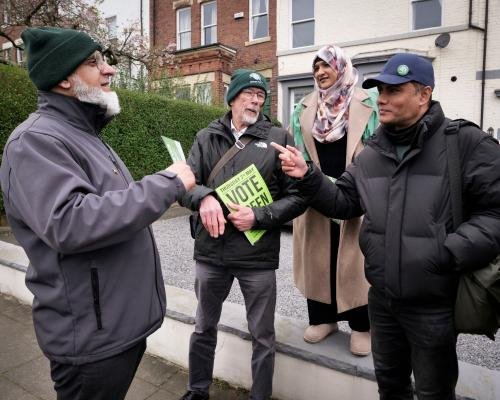
Mohammed Suleman, who describes himself as a direct-speaking resident of northeast England, is not particularly fond of politics. As a taxi driver and entrepreneur, he prioritizes community projects. In past elections, he chose Labour as the better option among limited choices. However, the Gaza conflict changed his perspective. Shortly after the conflict began, which a United Nations panel later labeled as genocide, Suleman and fellow mosque members started a petition urging their local Labour MP in Newcastle upon Tyne Central and West, Chi Onwurah, to support a ceasefire. He viewed it as a symbolic gesture emphasizing the value of Palestinian children’s lives, who share his heritage and religion. ‘Her decision to abstain was the final straw,’ Suleman explained. He shared this ahead of door-to-door campaigning in Arthur’s Hill, located west of Newcastle. The city is frequently seen as divided, with a predominantly white working-class population in the east and greater diversity in the west, both traditionally key to Labour’s support. While Labour has focused on appealing to voters in the east, it has been less attentive to significant changes among Muslim communities. During recent conversations in Newcastle, Suleman and about a dozen other Muslim activists and residents expressed a strong belief that Labour has neglected their neighborhoods for years. Despite long-term Labour control of the local council, people highlight vandalized and closed businesses, reduced public services, and the party’s mild stance against far-right growth as signs of disconnection. This pattern extends beyond Newcastle. In places like Gorton and Denton, where Hannah Spencer secured the Green Party’s inaugural by-election win, and in races across Birmingham, Leicester, and east London, Labour is losing ground among Muslim voters. The shift is notable enough that Health Secretary Wes Streeting, who narrowly retained his Ilford North seat by fewer than 500 votes, has voiced concerns about vulnerability in once-secure local districts. Forthcoming local elections may reveal if this reflects temporary dissatisfaction or a lasting realignment. For Suleman, Onwurah’s abstention was pivotal, yet it formed part of ongoing frustration. The emergence of far-right elements prompted him to transition from disliking politics to running as a Green Party council candidate. The 2024 summer disturbances involving attacks on mosques, arson at asylum accommodations, assaults on women in hijabs, and mob violence against individuals evoked memories of his difficult school experiences. ‘There were designated times for targeting people like me, known as ‘Paki bashing’,’ he recalled. He was frustrated to witness similar hatred spreading amid escalating living costs. Suleman sees the Greens as the strongest opponent to far-right influences. He also credits Khaled Musharraf, who surprisingly won a Green council seat in his area in 2024, for his decision to join. Similar to Hannah Spencer, a plumber with local fame, Musharraf is recognized for his dedicated community efforts. Having voted Green for ten years, Musharraf came to the UK from Bangladesh, where childhood memories include devastating floods that paralyzed the nation. ‘Numerous Muslims originate from regions most affected by climate change,’ he noted, arguing that the community’s attraction to the Greens is often oversimplified as solely related to Gaza. Mosques are now incorporating discussions on environmental challenges, driven by younger British Muslim leaders. Research from More in Common UK indicates that Muslim voters prioritize everyday concerns like economic pressures, safety, and community resources. Luke Tryl, the organization’s executive director, compared Gaza’s influence on these voters to Brexit’s role in eroding Labour’s traditional strongholds. ‘It highlighted longstanding sentiments of being undervalued and ignored, leading to the divide,’ Tryl stated. Sharmen Rahman, the Green Party’s national representative for equality and diversity, referenced data from the Labour Muslim Network showing a persistent pattern. In 2020, nearly 47% felt Labour inadequately represented Muslims, rising to 63% by 2022. Suleman meets with his close group of council members, relatives, and allies at an Italian café in Newcastle’s Elswick ward before campaigning. Among them is Halimah Begum, motivated to run due to her background in counseling and youth programs. She departed from Labour following a Keir Starmer interview on immigration, where he implied deportations to Bangladesh. Begum interpreted this as stereotyping all British-Bangladeshis as undocumented. ‘I see myself as Bangladeshi, British, and Muslim, with these identities coexisting,’ she said.