

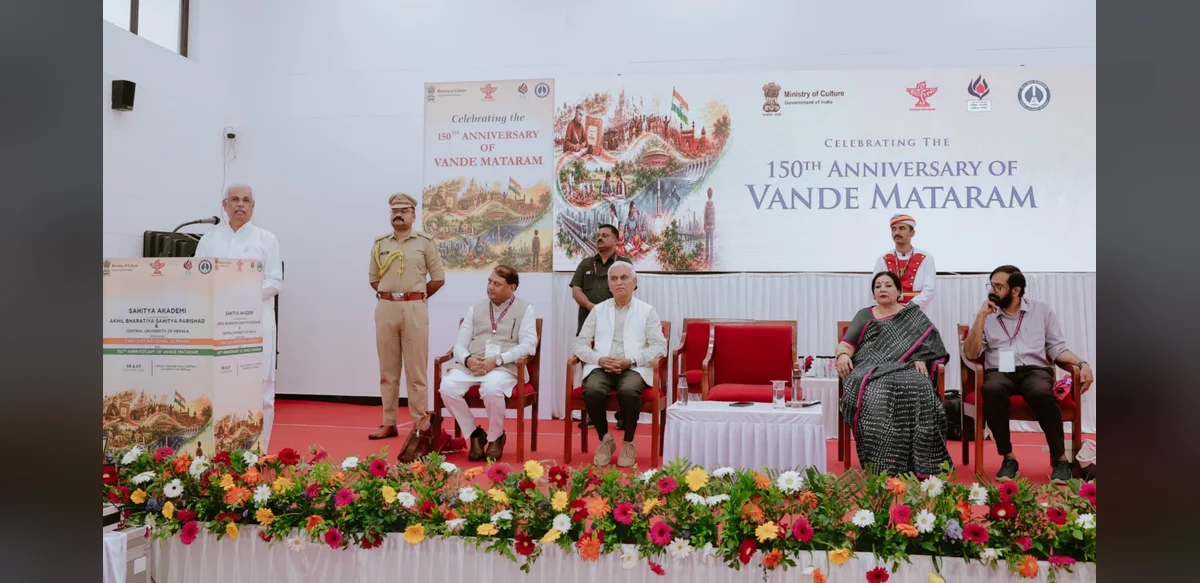
Kerala Governor Rajendra Vishwanath Arlekar has called for an in-depth academic examination of the origins and broader effects of the national song Vande Mataram. Speaking at the conclusion of a two-day national seminar held at the Central University of Kerala, the governor emphasized the need to document the historical context surrounding its creation and its role in fostering unity during the independence movement. The event marked the 150th anniversary of the composition and was organized jointly with the Sahitya Akademi and Akhil Bharatiya Sahitya Parishad.
The governor stressed that the circumstances leading to the writing of the song by Bankim Chandra Chattopadhyay deserve careful scholarly attention. He noted that details about the motivations behind its creation and the reasons Rabindranath Tagore viewed it as a unifying national anthem should be compiled into a formal research publication. Such a document, he argued, would serve as a lasting reference for younger generations rather than remaining limited to spoken remarks at public gatherings.
Arlekar also highlighted the importance of examining opposition to the song. He described recent protests as part of a wider pattern and urged society to identify the underlying ideas and groups involved. Vigilance at every level, from national institutions to local communities, was presented as essential. Beyond identification, he advocated for active social engagement to address these tendencies and preserve shared national traditions.
The address underscored that Vande Mataram functions as more than a musical piece. It represents a collective sense of identity that helped bring diverse regions together during the freedom struggle. Even the simple phrase, without the full melody, carried the capacity to inspire solidarity across the country. This shared awareness challenged colonial authority by demonstrating the potential strength of a united population.
The governor cautioned against restricting discussions to technical aspects such as the number of stanzas. Instead, he encouraged focus on the underlying sentiment and the way the composition contributed to the broader awakening that supported the independence effort. He suggested that the present moment calls for renewed attention to this unifying spirit to strengthen contemporary national cohesion.
Research efforts, according to the governor, should extend beyond verbal presentations. A systematic review of the social and political environment during the time of composition, the process by which the song became associated with the freedom movement, and its measurable influence on public sentiment would produce a valuable national record. Publication of these findings as a book would ensure the material reaches future readers in an authoritative form.
Concern was expressed regarding attitudes that question participation in singing the song. The governor recommended that conversations on this topic move outside academic settings and involve everyday interactions among neighbors, coworkers, and various community groups. He linked the issue to wider efforts to protect institutional integrity and cultural continuity.
The speech connected the topic to the principle of Ek Bharat Shreshtha Bharat, stressing that unity remains vital for the country to maintain its global standing. Divisive approaches were described as risks that could undermine collective progress. When the nation stays cohesive, external challenges become less significant, the governor observed.
India possesses recognized capabilities on the international stage, making internal solidarity increasingly relevant. Every citizen was invited to contribute to this ongoing process of national strengthening. The governor concluded by noting that individuals should be able to reflect with satisfaction on their personal involvement in preserving these values rather than remaining passive observers.
The seminar provided a platform for participants to explore these themes through structured academic exchange. The governor’s remarks framed the anniversary as an opportunity to reinforce awareness of shared heritage while encouraging practical steps to document and disseminate historical understanding. The call for both scholarly documentation and broader public dialogue aimed to ensure that the song’s significance continues to inform contemporary discussions on national identity and collective responsibility.


