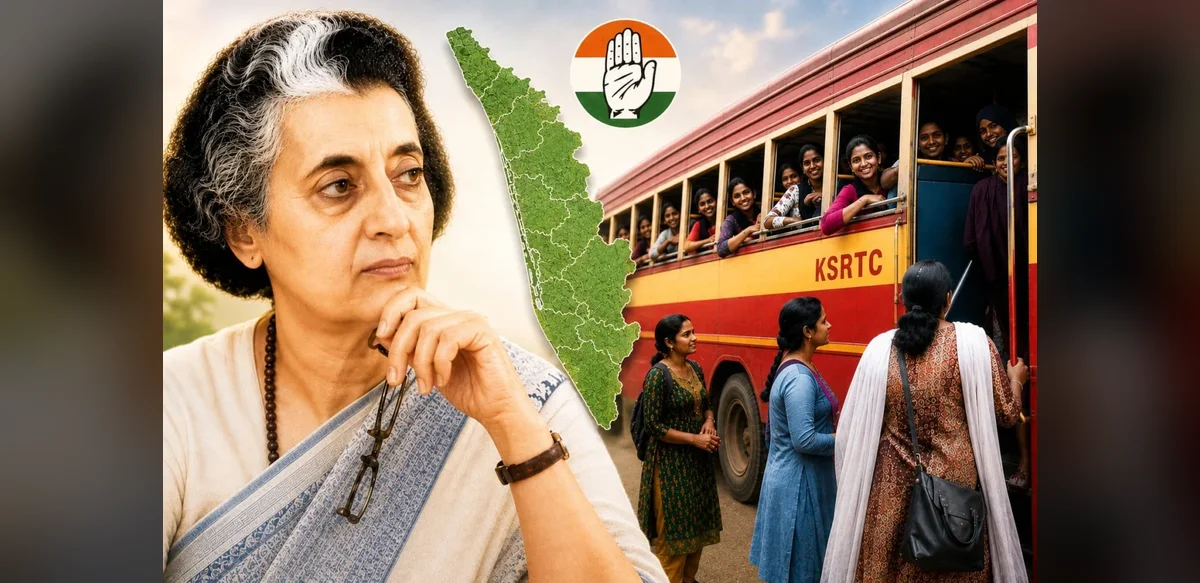
When Indira Gandhi declared a national Internal Emergency in June 1975 under Article 352, the country saw major restrictions on rights, judicial autonomy, police actions, and political detentions. Kerala has its own place in constitutional events. In 1959 the central government under Jawaharlal Nehru used Article 356 to remove the communist government headed by E.M.S. Namboodiripad. However, Article 360, allowing a presidential declaration of Financial Emergency when national or regional financial stability is at risk, has never been applied in independent India. In May 2026 the United Democratic Front government, headed by Chief Minister V.D. Satheesan of the Indian National Congress and the Indian Union Muslim League, took office in Kerala. Soon after, it introduced the Priyadarshini scheme, one of its main election pledges. The programme, named after Indira Priyadarshini Gandhi, offers free rides for women and transgender individuals on 3,125 regular and local KSRTC buses. Presented as support for women’s empowerment and inclusion, the scheme’s name highlights an economic contrast. As the new administration begins its term, rising costs of subsidies together with existing economic difficulties have prompted questions about whether such measures could lead to serious fiscal problems. The mention of Financial Emergency here is only symbolic and is used to describe the state’s difficult budget situation. It does not suggest or predict any formal declaration under Article 360. Kerala’s public finances have been under strain for years, marked by large off-budget debts, high revenue shortfalls, and heavy borrowing for routine spending. Total state debt is around 4.5 lakh crore, or 36.8 per cent of GSDP, ranking the state among India’s most pressured alongside Punjab and West Bengal and well above the 20 per cent guideline in the Fiscal Responsibility and Budget Management framework. The Priyadarshini scheme arrives when KSRTC already faces major losses. The corporation earns about 144 crore monthly but spends 234 crore on operations, creating a 90 crore monthly shortfall and total liabilities over 2,000 crore, according to state audit reports for 2025-26. Adding the lost fares from the scheme brings an extra monthly cost of 60 to 70 crore, or roughly 800 crore a year. To cover the difference the government has increased borrowing within limits set by the central finance ministry, turning transport income into a continuing budget burden. Broader economic conditions add to the challenge. Despite a 96.2 per cent literacy rate, Kerala has one of the highest youth unemployment figures, often above 25-28 per cent for ages 15-29, with many educated residents leaving for work elsewhere. Manufacturing stays limited at about 9.8 per cent of the economy because of high land prices, environmental rules, and difficulties in acquiring land.