


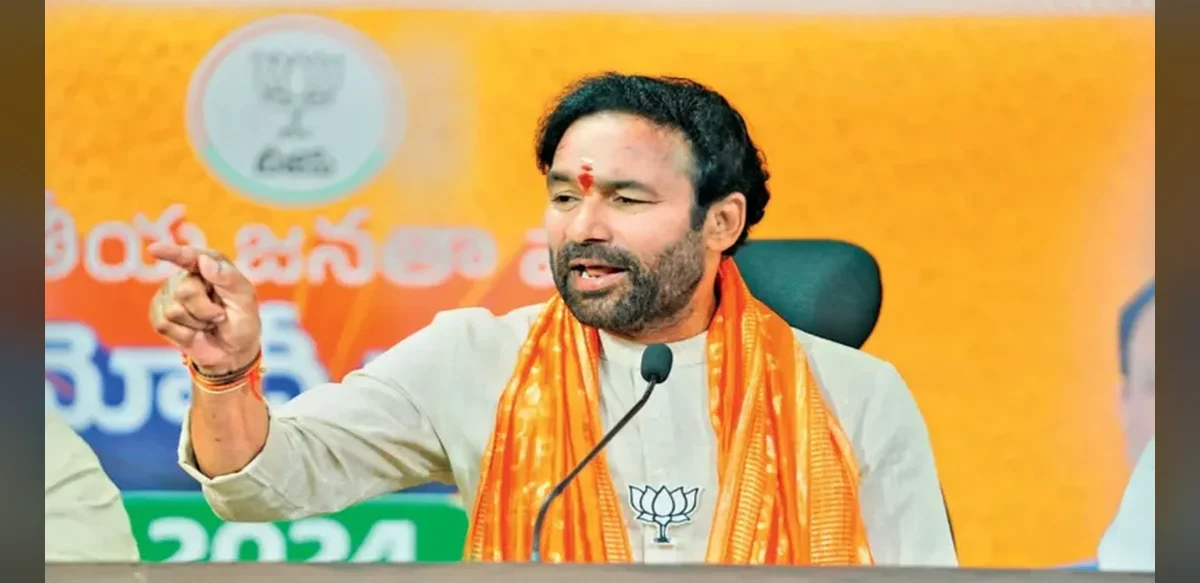
Hyderabad: Union Minister and Telangana BJP president G Kishan Reddy has charged the Congress-led state government with safeguarding the political interests of the MIM in a controversy over the Barrister Fatima Owaisi Educational Campus. The campus is reported to lie within the full tank level and buffer zone of Salkam Cheruvu in Bandlaguda Kalsa.
In a social media statement, Reddy asked whether the government’s stance reflected fear of the MIM, affinity toward it, or both. He claimed authorities acted quickly against ordinary residents but showed inaction regarding the educational site.
Reddy stated that the government’s focus on revenue from land deals led it to overlook public welfare while extending protection to the Majlis party. He described the lake protection agency as applying rules unevenly, acting firmly against common citizens yet hesitating when the campus allegations arose.
His comments followed ongoing hearings at the Telangana High Court on a petition regarding constructions at the institutions. On July 3 the court directed the municipal corporation, irrigation department and other bodies to file reports within seven days detailing permissions granted for the buildings, the full tank level status and approvals for educational use.
The court expressed concern that earlier orders from April 13 and April 30 had not produced complete information after nearly three months. It warned that failure to comply would prompt further orders.
The petition, filed by advocate Vijay Gopal, alleged unauthorized construction inside the full tank level and buffer zone of the lake. The petitioner noted that complaints submitted between August and September 2024 had not resulted in enforcement action, unlike other encroachment cases.
Reddy maintained that despite court observations and requests for records from multiple departments, the government had not shown the same speed applied to ordinary citizens. He accused the administration of shielding the MIM for political advantage and of treating the party as the sole representative of Muslims, a claim he rejected.
He added that demolitions had affected poor families, including Muslims, without protest from either the MIM or Congress, yet both appeared united when the campus issue surfaced. Reddy concluded that the episode revealed vote-bank considerations and double standards, urging uniform application of the law without communal or political bias.

