


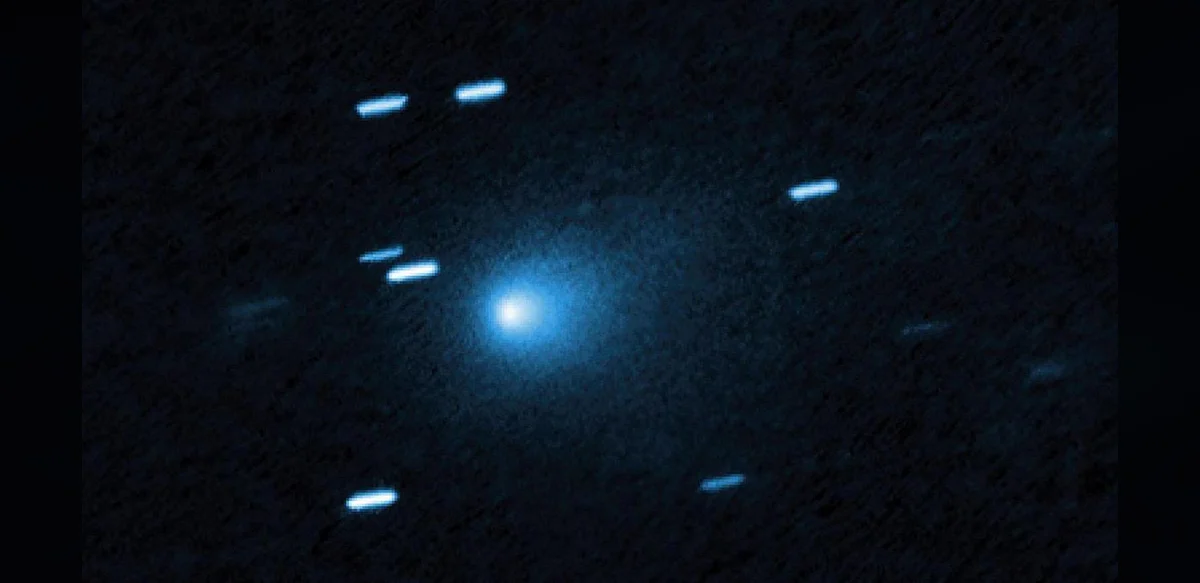
Researchers examining comet 3I/ATLAS have concluded that this interstellar object is extremely old, having formed roughly 10 to 12 billion years ago in an early planetary system with a makeup unlike any found in our own solar system.
Analysis of its chemical composition, the third such interstellar body detected passing through the solar system, revealed details about the physical and chemical conditions present where it originated.
Measuring about 2.6 kilometers across, the comet is likely the oldest known object to travel through the solar system, according to Martin Cordiner, a NASA planetary scientist and lead author of the study published in Nature.
The team noted that 3I/ATLAS appears to have formed in a much colder setting, around minus 243 degrees Celsius, compared with the environment that produced Earth and other solar system bodies about 4.5 billion years ago. It has since traveled far after being ejected from its original system.
The scientists used the James Webb Space Telescope to measure isotope ratios of elements such as hydrogen and carbon on the comet. Hydrogen isotopes indicated the temperature and radiation levels at its formation site, while carbon ratios provided clues about the gas cloud that created both the comet and its home system.
The comet’s water showed roughly 30 times more deuterium than solar system comets, and its carbon isotope ratios differed from those in solar system objects and nearby interstellar clouds or planet-forming disks.
Cordiner stated that 3I/ATLAS is probably a remnant from planet formation around another star. Observations indicate its host system was colder, less rich in metals, and exposed to higher levels of ultraviolet and cosmic radiation than our solar system.
Despite its distant origin, the comet contains abundant organic molecules with carbon, hydrogen, nitrogen, oxygen and sulfur, suggesting that the building blocks for life were present in that environment.
Its carbon makeup points to formation as early as 12 billion years ago during a period of intense star formation, when the universe was about 13 percent of its current age. The researchers think it originated in the Milky Way but cannot exclude another galaxy.
They suggest gravitational interactions with planets or a collision could have ejected it. The two previously observed interstellar objects were 1I/’Oumuamua in 2017 and 2I/Borisov in 2019.
3I/ATLAS is now nearing Saturn’s orbit and is expected to pass Pluto’s orbit in 2029 before leaving the solar system around 2035. The team confirmed it is a natural comet based on early and ongoing observations.

