


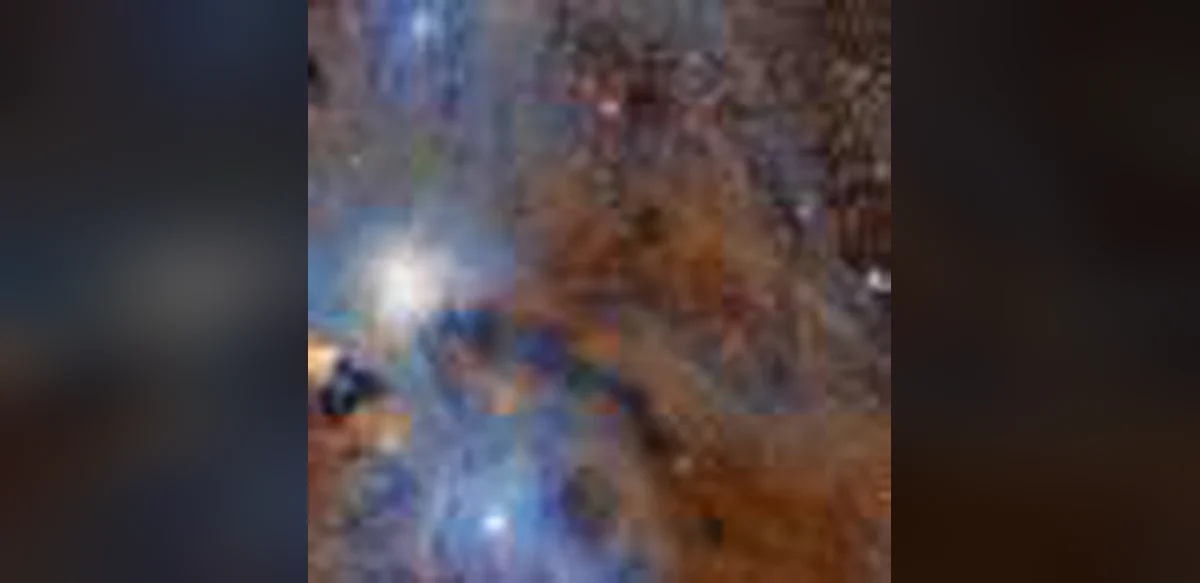
The 570-megapixel Dark Energy Camera has produced an image of the Corona Australis Molecular Cloud that echoes the swirling patterns of Vincent van Gogh’s The Starry Night. The view shows the glowing nebula NGC 6729 on one side and the globular cluster NGC 6723 on the other. The camera is installed on the Víctor M. Blanco 4-meter Telescope at Cerro Tololo Inter-American Observatory in Chile.
Located within the constellation Corona Australis, the molecular cloud lies roughly 430 light-years from Earth and ranks among the nearest star-forming areas to the solar system. The left portion of the frame contains this cloud, while the overall composition displays vivid eddies of color and light.
The instrument features 74 detectors and a lens nearly one meter wide, enabling detailed captures of fine celestial structures. Within a small orange cloud on the far left sits the binary star R Coronae Australis, whose members orbit each other every 43 to 47 years. The primary star is still gathering mass and has not begun hydrogen fusion.
Light from young stars reflects off surrounding material to form reflection nebulae, while ultraviolet radiation ionizes gas to create emission nebulae. These combine in NGC 6729, whose appearance shifts with the binary orbit. Additional reflection nebulae NGC 6726, NGC 6727, and IC 4812 extend across the field.
In the upper right appears the globular cluster NGC 6723, known as the Chandelier Cluster, containing tens of thousands to millions of stars and positioned about 29,000 light-years away. The region attracts astrophotographers, especially as summer places the constellation favorably for southern observers.

