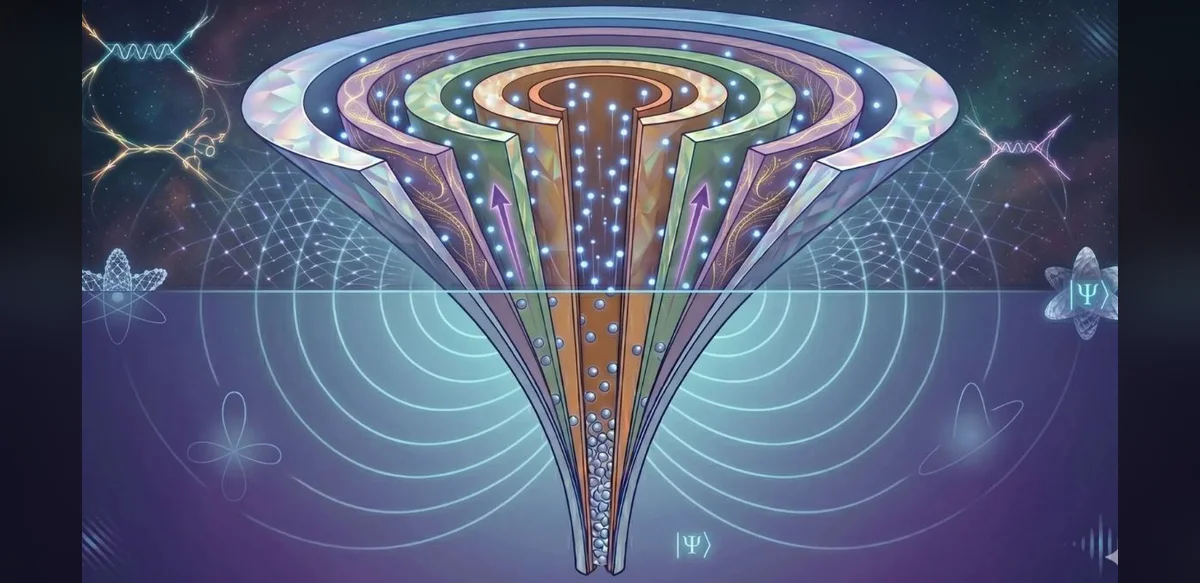
At extremely low temperatures, atomic behavior follows unusual quantum rules. When cooled near absolute zero, atoms can conduct electricity without resistance, form unified clouds, or move without friction while climbing container walls. These conditions are governed by quantum statistics that dictate how bosons and fermions act. Bosons can share quantum states and overlap like waves, while fermions obey the Pauli exclusion principle and cannot occupy the same state. Researchers used these principles to produce a new quantum phase resembling a fractional Fermi sea. They began by forming a Bose gas from roughly 70,000 cesium atoms at a few nanoKelvin. The atoms were held in one-dimensional tubes created by an optical lattice of lasers. Scientists then applied repeated cycles that switched the atoms between strong repulsion and strong attraction. This process generated an unexpected ordered state in which quantum states are only partially filled. The resulting matter showed hidden correlations and Friedel oscillations rather than random heating. The team remains uncertain what to call the quasiparticles but suggests the label super-Fermions. The experiment demonstrates how quantum simulation can produce states beyond existing models and may aid future advances in quantum sensing and information processing.