


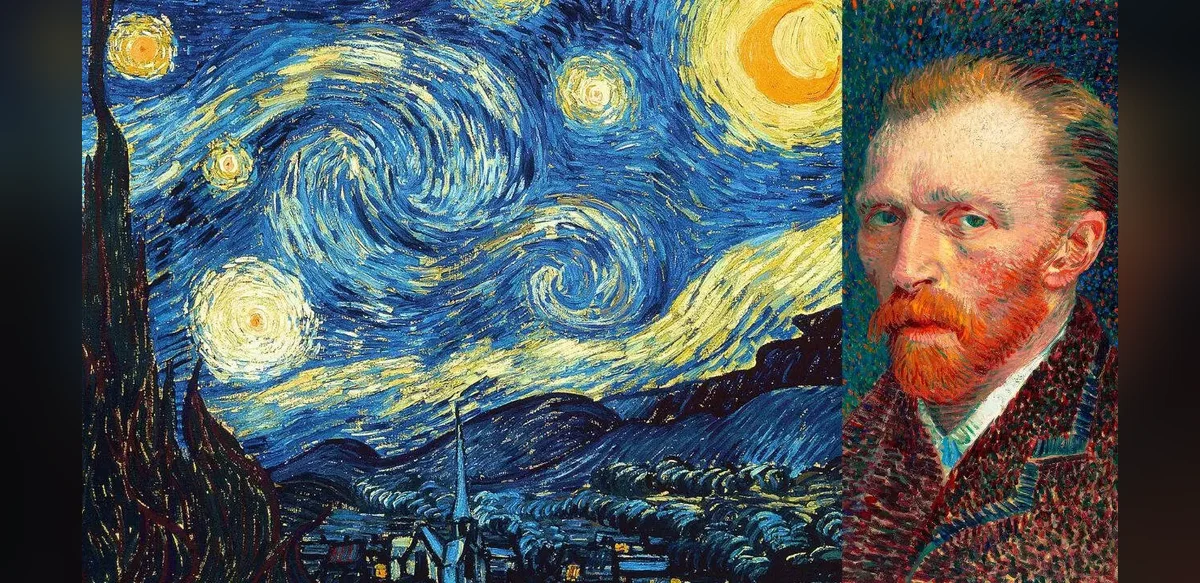
Many viewers see The Starry Night as a moonlit village under a sky of swirling stars. Physicists examining the same work noticed something different. Within the blue spirals lies a pattern that matches turbulence, one of nature’s complex phenomena.
The painting was created by Vincent van Gogh in June 1889 during his stay at the Saint-Paul-de-Mausole asylum in southern France. It has often been connected to his mental condition after a breakdown, with art historians viewing it as an expression of inner turmoil.
The work is now among the most famous paintings worldwide and appears on many everyday items. Its scientific insight, however, came from physicists rather than art experts.
Turbulence occurs widely in nature, including rivers, ocean currents, smoke, clouds and blood flow. Fluids form swirling structures that break and reform in ways that are chaotic but follow certain patterns.
In 1941 mathematician Andrey Kolmogorov created a statistical theory describing energy movement in turbulent flows. More than sixty years later, researchers tested whether the painted sky followed similar rules.
Analysis of brightness variations across the canvas showed changes that closely matched expected turbulent motion. Published in Physics of Fluids, the study indicated the painting captured turbulence’s visual rhythm with high accuracy.
Similar patterns appear throughout the work in rising smoke, moving clouds, flowing rivers and even cream in coffee. The finding does not imply Van Gogh knew advanced mathematics. Researchers suggest he achieved the effect through careful observation of natural movement.
Van Gogh spent extended periods watching skies, landscapes and light. He painted what he observed and felt, reproducing the night sky’s motion so precisely that modern physics later identified matching patterns.
Turbulence remains difficult to predict fully despite its role in weather, aviation, ocean currents and astrophysics. The painting connects art with an unsolved physics problem, which continues to draw scientific attention.
Researchers have noted comparable patterns in other works, such as John Constable’s Chain Pier, Brighton, and in images of Jupiter’s Great Red Spot from NASA’s Voyager 1 mission in 1979.
The Starry Night is now held at the Museum of Modern Art in New York.

