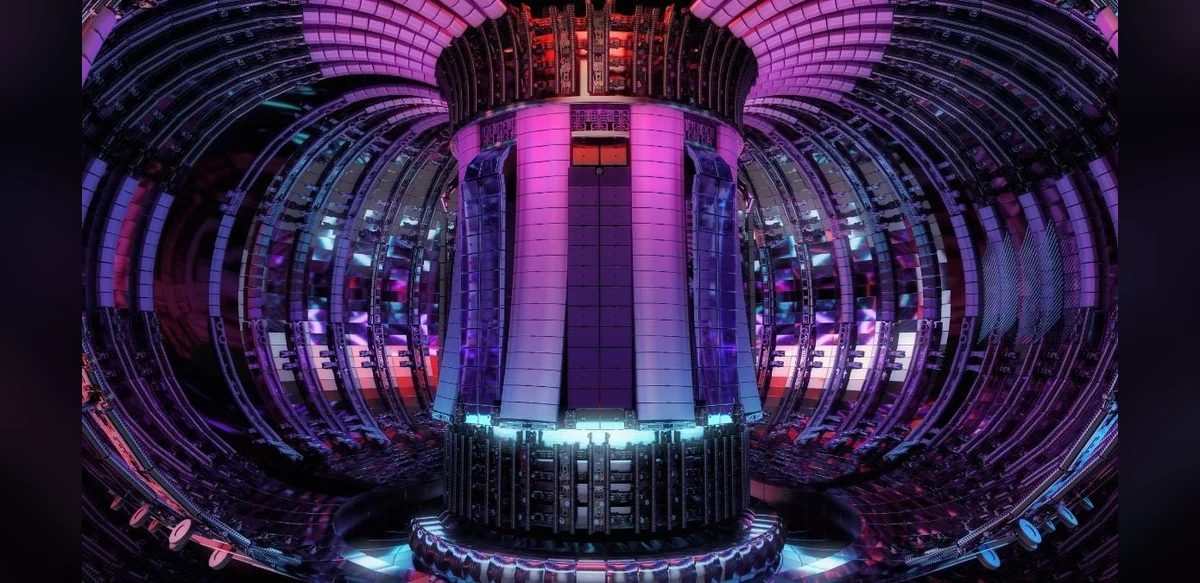
A key challenge in developing nuclear fusion energy lies in securing a reliable fuel supply. Most proposed tokamak reactors would rely on fusing tritium and deuterium, two hydrogen isotopes. This reaction yields helium, a neutron, and 17.6 megaelectronvolts, offering a high reaction rate and energy output. Tritium, however, is scarce on Earth and occurs only in trace atmospheric amounts from cosmic rays. Efficient breeding methods could make it viable. Researchers have now applied quantum-centric supercomputing for the first time to identify nine molecular configurations of FLiBe, a molten lithium-beryllium fluoride salt used in reactor blankets to produce tritium from neutron bombardment. The work draws on techniques previously used for protein modeling. Fusion is viewed as a low-emission source with minimal radioactive waste compared to fission, yet progress remains limited to labs. Recent milestones include a 2022 breakeven at Lawrence Livermore and extended plasma durations of 1,337 seconds. The new simulations reveal details on FLiBe electronic structure, atomic behavior, and bonding, allowing scientists to prioritize promising configurations for later lab tests and avoid costly dead ends. Results support the growing role of such computing in materials challenges, though real-world validation is still required. A preprint appears on arXiv.