


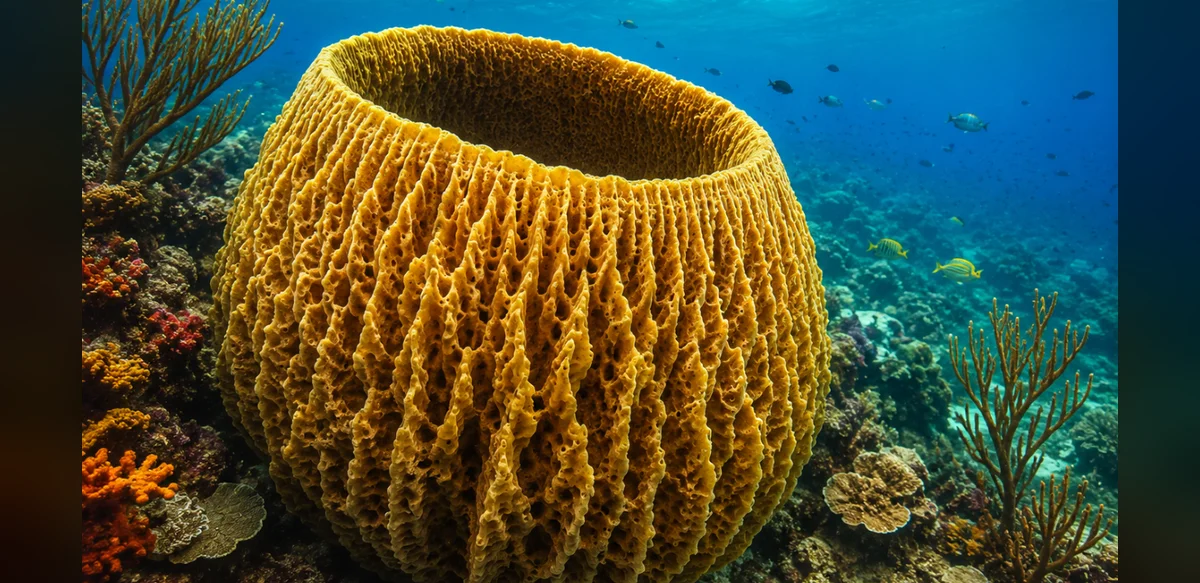
A living marine organism may have existed through more than two thousand years of history. Scientists have identified a giant barrel sponge in the Caribbean believed to be approximately 2,300 years old, potentially ranking among the oldest known animals. The creature likely began growing as a larva near the time of ancient historical events and has remained attached to the seafloor since then. Confirmation through additional studies could reveal how certain sea life endures for millennia while filtering water and supporting reef systems.
Sponges rank among the earliest multicellular animals, with fossils indicating their presence more than 600 million years ago. These fixed organisms draw water through internal channels to capture food and oxygen. Research on the Florida Keys population of Xestospongia muta suggests the Caribbean example reached its reported age through very slow expansion.
Such sponges earn the nickname redwoods of the reef due to their large size and extended lifespan. Age estimates rely on growth rate data, mathematical models, and radiocarbon methods rather than visible rings. Related work in the Indo-Pacific region indicates annual increases of only millimeters to centimeters, enabling some individuals to surpass 1,000 years.
Further independent verification is required to substantiate the 2,300-year figure. Beyond longevity, these sponges play key roles by processing large volumes of seawater, removing microbes, and recycling nutrients essential to reef health. Older specimens also retain chemical records useful for reconstructing past ocean conditions and climate patterns.
As seas warm, insights into the resilience of these organisms may aid efforts to protect coral ecosystems and marine diversity.

