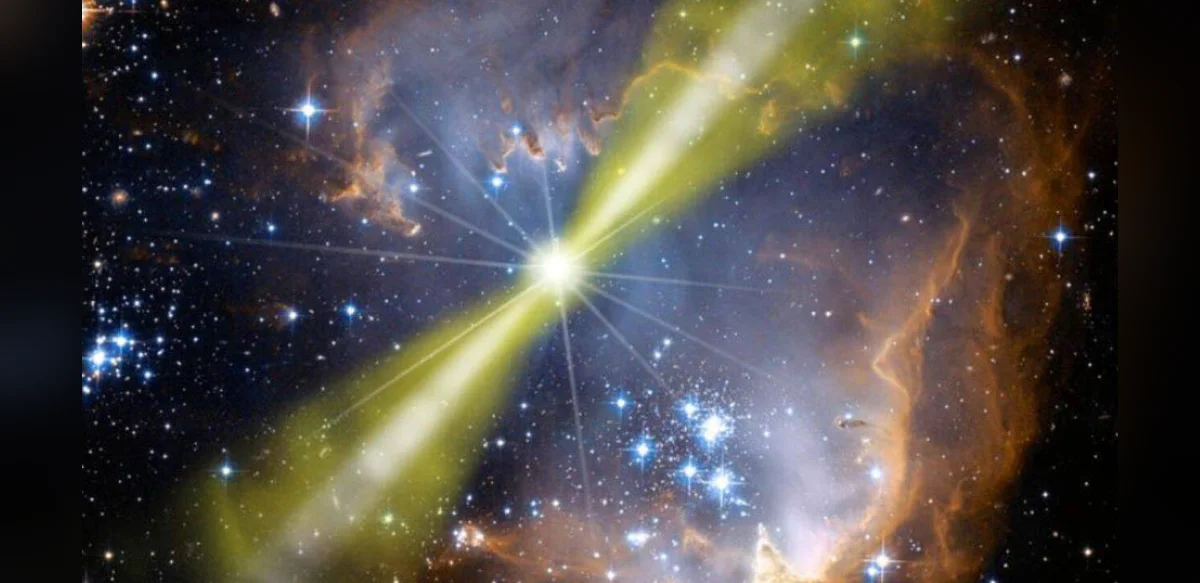
For over fifty years gamma-ray bursts have stood among the most mysterious phenomena seen in space. These events consist of sudden intense flashes of gamma rays that can arrive from any direction and persist from fractions of a second to several minutes. The first such burst was recorded by chance in July 1967. At that time the United States satellites Vela 3 and Vela 4 were orbiting to verify compliance with the Nuclear Test Ban Treaty by detecting possible nuclear explosions. Instead the instruments registered brief surges of high-energy photons originating from beyond Earth. Researchers initially could not identify the source. Some suspected events inside the solar system or Milky Way while others considered more remote origins. No obvious counterpart remained after each flash faded. The Vela spacecraft carried sensors for X-rays gamma rays and neutrons intended to spot nuclear detonations. Data from sixteen similar events recorded between 1969 and 1972 were analyzed and published in 1973 leading to the conclusion that the bursts originated outside the galaxy. Soviet Konus satellites supplied confirming measurements in 1974. Beginning in 1976 the Interplanetary Network combined detectors aboard solar and planetary probes to locate bursts by triangulation narrowing positions to a few arc minutes and ruling out known galactic X-ray sources. The Compton Gamma Ray Observatory launched in 1991 carried the BATSE instrument which recorded more than 2700 bursts over nine years. The uniform sky distribution indicated an extragalactic population rather than sources concentrated in the Milky Way plane. This implied enormous energy releases if the events lay billions of light-years distant. In 1997 the BeppoSAX satellite detected an X-ray afterglow allowing precise follow-up observations that confirmed extragalactic distances. Subsequent studies showed peak luminosities reaching 100 billion billion times the Sun and revealed elements such as iron silicon sulfur and argon linked to supernova activity. In 1999 rapid detection of the afterglow from GRB990123 demonstrated that energy is focused into narrow jets visible only when pointed toward Earth. Additional observations of iron absorption features in other bursts reinforced connections to the collapse of massive stars.