


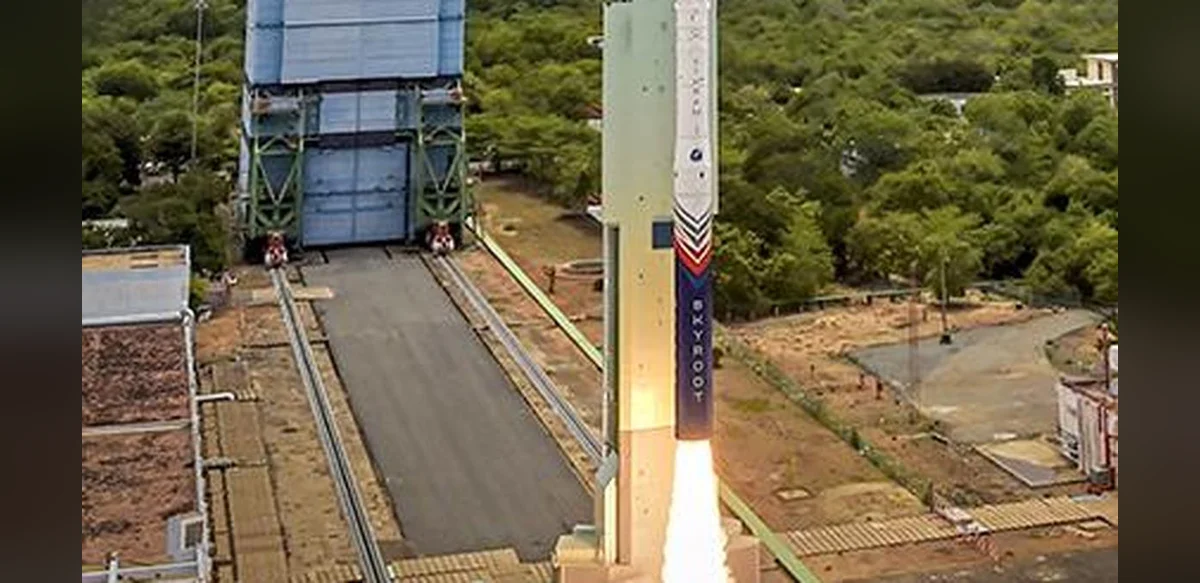
India completed its first private orbital rocket launch at 12.05 p.m. on July 18. Until now, all Indian orbital rockets had been developed and operated under government funding through the Indian Space Research Organisation. Hyderabad-based Skyroot Aerospace altered this pattern by sending its Vikram-1 small-satellite launch vehicle into low-Earth orbit. The flight was named Mission Aagaman.
Since 2020, policy changes have permitted private firms to develop launch vehicles and use ISRO facilities. Globally, only a few companies have reached orbital capability, among them SpaceX, Rocket Lab, Firefly Aerospace and several Chinese enterprises. Others, such as ABL Space Systems and Isar Aerospace, continue development.
A successful debut flight marks a notable achievement. Many vehicles, including Falcon 9, encountered setbacks on first attempts. Yet the milestone also highlights the commercial environment Skyroot now faces. One launch alone will not ensure sustained success. The small-satellite market remains competitive, with uncertainties around demand and pricing.
Founded in 2018 by former ISRO engineers Pawan Kumar Chandana and Naga Bharath Daka, Skyroot first flew the suborbital Vikram-S in 2022. Vikram-1 is a four-stage vehicle using solid propellant in the initial three stages and liquid propellant in the final stage. Once production is optimised, the company expects to manufacture one rocket per month.
Mission Aagaman served as a developmental test, verifying stage separation, propulsion, guidance, structural integrity, avionics, fairing release and orbital insertion. Reaching the planned orbit represented the most demanding requirement.
The rocket carried secondary payloads, though the primary objective remained vehicle validation. Vikram-1 can deliver 290 kg to a 500 km sun-synchronous orbit or 480 kg to a low-inclination orbit at similar altitude. Two further developmental flights are planned before commercial operations begin.
Future plans include Vikram-2, designed for up to 1,000 kg to low-Earth orbit with a first flight targeted for 2027, and a fully reusable vehicle.
While technical success is important, building a viable business presents separate challenges. Demand forecasts for 100-500 kg satellites have not fully materialised for every operator. Many customers now choose rideshare flights on larger vehicles, lowering prices. Dedicated small-satellite launches offer schedule flexibility but at higher cost.
Skyroot may benefit from lower manufacturing expenses in India, access to ISRO infrastructure and national manufacturing initiatives. Competing efforts are underway in Europe, the United States, China, Japan and Australia.

