


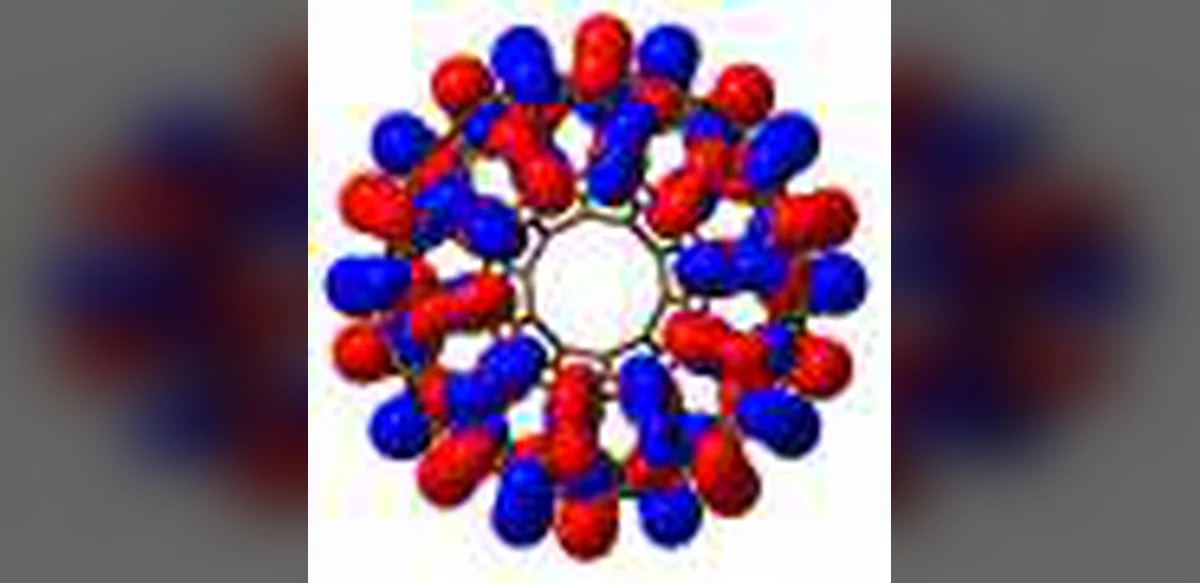
Quantum states can be controlled accurately using minuscule carbon rings only a few nanometers across. This relies on toroidal moments, a seldom-applied type of electromagnetic dipole. Through computer modeling, researchers at Martin Luther University Halle-Wittenberg showed how these structures can be created and managed without energy loss. The results, reported in npj Computational Materials, point to fresh options for quantum technologies.
Standard dipoles include electric ones, seen in batteries and antennas, and magnetic ones, produced by moving charges or permanent magnets. Toroidal dipoles form a third category of charge-current arrangements that have proven hard to realize at molecular scales. They can be visualized as a closed current loop whose internal magnetic field stays contained and produces no external fields.
At larger sizes, such as centimeter-scale coils, toroidal systems function reliably. At the nanoscale, however, currents become inefficient and losses rise sharply. The Halle team used simulations to demonstrate that ring-shaped carbon molecules, resembling tiny doughnuts, can host stable toroidal moments when a steady electric field is applied. Electrons then circulate in a three-dimensional vortex around each ring.
The models indicate these moments can be generated loss-free, then excited, adjusted, or reversed at will. Such control could benefit quantum computing, particularly in managing superconductors that carry current with minimal resistance. Unlike conventional magnetic or electric fields, which are difficult to confine at small scales and can disturb neighboring particles, toroidal moments act directly on quantum phases within the carbon structures.

