


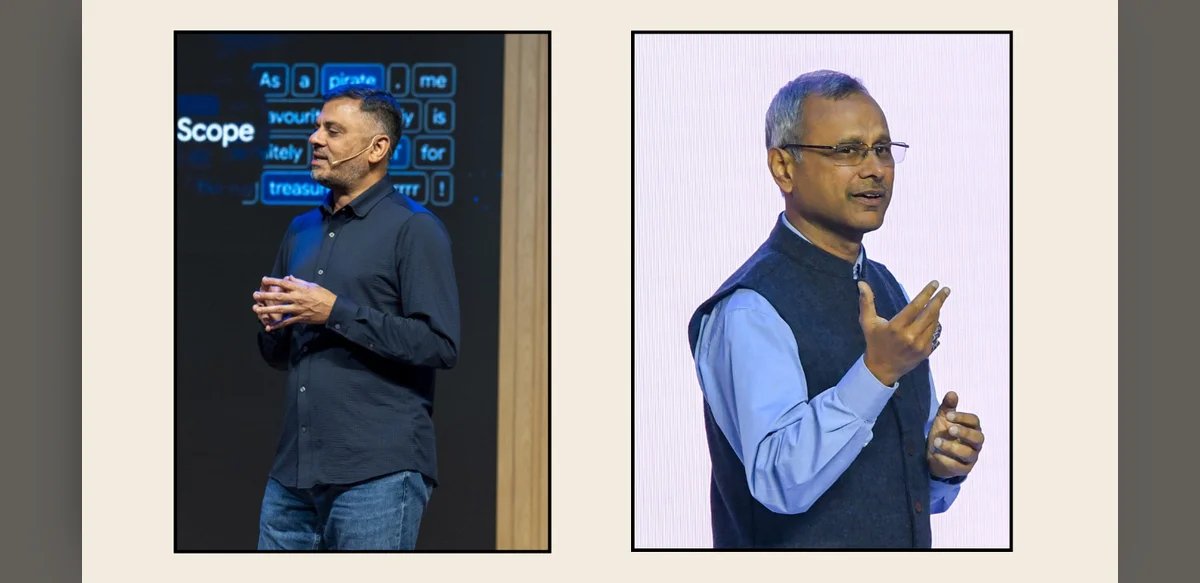
Alphabet CEO Sundar Pichai recently noted in a podcast that Google trails somewhat in AI coding tools. The comment raises relevant questions for the two leaders overseeing Google DeepMind operations in India, a key location for refining Gemini models to be more affordable, quicker and practical for developers.
Manish Gupta, who directs research at Google DeepMind India, and Seshu Ajjarapu, who leads applied AI there, confirm that narrowing the coding shortfall ranks among the company’s highest internal priorities.
“Code is a top priority — P0, P1 and P2,” Mr. Ajjarapu said, referring to Google’s designation for critical initiatives. Coding work supplies measurable outcomes and requires clear logical steps, which in turn improves overall model performance.
The executives described an India-based team focused on globally applicable work. Mr. Gupta highlighted a Matryoshka-inspired transformer method created in Bengaluru that places smaller models within a larger one. First used in the Nano 3 model on Pixel phones, the technique activates only the needed model size for each task, saving battery power. The approach is now being adapted for server use to reduce computing expenses.
Both executives said this focus on efficiency stems from Indian market conditions. Mr. Gupta noted strong interest in cost-effective models due to population size and price sensitivity, with resulting methods helping make Gemini models more efficient overall.
Mr. Gupta also described efforts to determine the appropriate level of computation a model should apply to different problems, avoiding both insufficient processing on complex tasks and unnecessary work on simple ones.
Much of the discussion addressed token usage volumes in current AI development and related cost controls. Mr. Ajjarapu spoke of delivering greater economic value by reducing cost per token while improving output quality, especially for agent-based applications whose results are less predictable.
He suggested future pricing could move from tokens to charges based on completed tasks.
Regarding enterprise data protection, Mr. Ajjarapu distinguished between public data used in pre-training and private data that models never access. Competitive advantage for companies lies in their own private data, processes and expertise rather than the base model. Mr. Gupta stated that contracts clearly assign data ownership to customers, with no learning from customer data and all training limited to the original pre-training set.
Beyond core model work, the India team has developed an agricultural model using satellite imagery to map field boundaries and crop types. The data is shared via API with Indian startups for insurance and credit products.
In healthcare, applications based on MedGemma target leprosy detection and reproductive health, with plans to open-source them for wider use in India.
Gemini now supports 25 Indian languages, including Sanskrit, with adoption reported among merchants in Surat and at Tata Steel for customer service and safety.
AI Overviews and AI Mode have produced double-digit growth in Search globally. Mr. Ajjarapu said the focus remains on user value first, with monetization addressed afterward.
Mr. Gupta noted that robotics research stays centered outside India, with the local lab’s role focused elsewhere.

