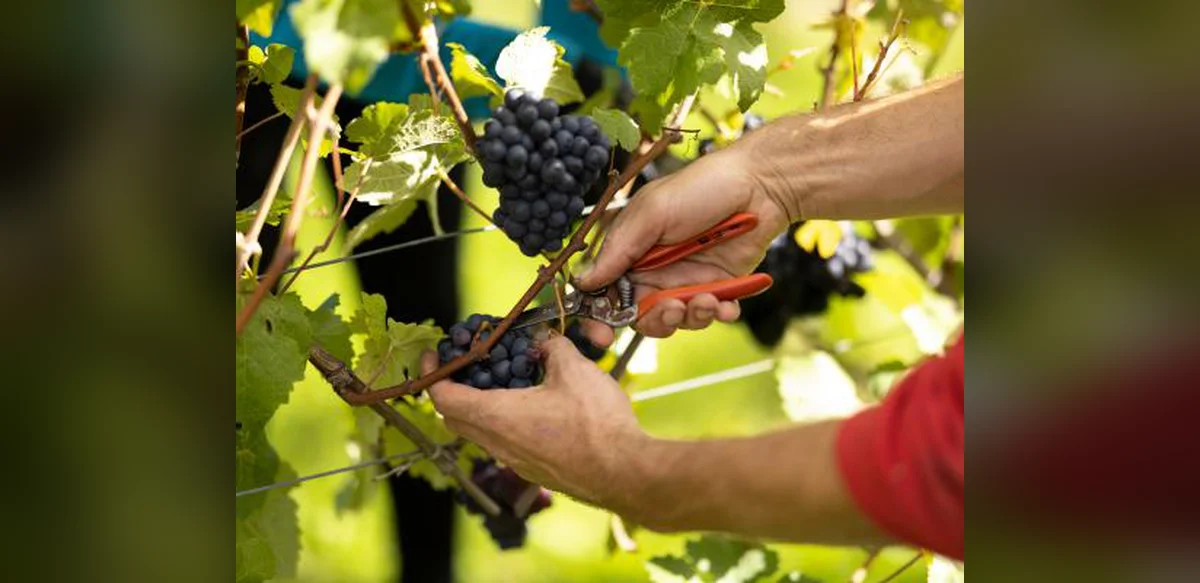
Vineyards cover the undulating countryside in Dorset, with plants currently at mid-height and mostly leafless under overcast spring conditions. Closer inspection reveals small fuzzy buds emerging as the vines awaken from winter rest for another season. By summer, these will bear chardonnay, pinot noir, and pinot meunier grapes, destined for English sparkling wine production at the Langham estate near Dorchester. Vines were first planted here in 2009 on land previously used for crops, and the operation has since created prize-winning wines that outperform some traditional European competitors. Justin Langham, the estate’s owner, explains from an onsite barn that he viewed viticulture as a means to broaden and enhance the family business while adding enjoyment. He notes that wine yields per acre far exceed those from wheat cultivation. Commercial grape growing in Britain has become viable due to advanced techniques and warmer temperatures. Langham observes that such activities would not have been feasible four or five decades ago. However, climate shifts also introduce difficulties for the emerging UK wine sector, such as erratic wet summers like 2024’s, which promote mold, diseases, and inconsistent harvests. Grapevines date back to Roman-era Britain, but modern vineyards now exist from southwest England to Wales, and northward to Yorkshire and Scotland. Official data shows over 1,100 registered vineyards in Britain, primarily professional ventures rather than amateur pursuits. Though the UK ranks low among global wine producers—trailing nations like Uzbekistan and Tunisia—it is the world’s quickest-expanding wine area, per real estate firm Knight Frank. The report indicates that vineyard acreage has quadrupled since 2000. The Langham property exemplifies this trend, growing nearly threefold since 2009 to cover about 34 hectares within a 1,000-hectare area. Rising output has necessitated expansion beyond repurposed farm structures for storage, prompting a £2 million investment in a new facility set for completion this summer. Nationwide growth has boosted overall wine volumes, though yields fluctuate, leading to variations between annual outputs and challenges in maintaining consistent quality. A warm, arid summer in 2025 enabled English and Welsh growers to achieve their second-biggest harvest, equivalent to 16.5 million bottles or 124,377 hectolitres. This surpassed triple the 5.3 million bottles from 2017, according to trade group WineGB, but fell short of 2023’s record 21.6 million bottles, as some plants recovered from 2024’s chill and dampness. Evolving weather affects conventional wine areas too, such as Spain, Italy, and southern California, where outputs are expected to decline sharply. Should climate change shift production northward, UK volumes may still not rival those of established regions. Lower production compared to nearby countries results in higher prices for British wines versus European options. Projections indicate continued increases in UK wine output, with the sector anticipating 25 to 29 million bottles annually by 2032 and a retail value of £1 billion for English and Welsh wines by 2040. Southeast England hosts more than half of UK vineyards, producing about two-thirds of domestic wine, especially in Kent, Sussex, Essex, and Hampshire. The nascent industry gains from accumulated expertise, says Nicola Bates, CEO of WineGB. She highlights Britain’s historical role in wine trade, with professionals gaining skills in places like New Zealand, Australia, and South Africa before applying them domestically. This knowledge increasingly improves vineyard performance and productivity each year. Harvesting grapes, along with bottling, promoting, and selling the wine, requires labor. The UK wine sector now employs around 10,000 people, including 3,500 in permanent positions, with the rest handling seasonal tasks like picking fruit and winter pruning. This marks a rise from 2,200 full-time workers two years prior. The industry provides more jobs per hectare than any other agricultural pursuit.