


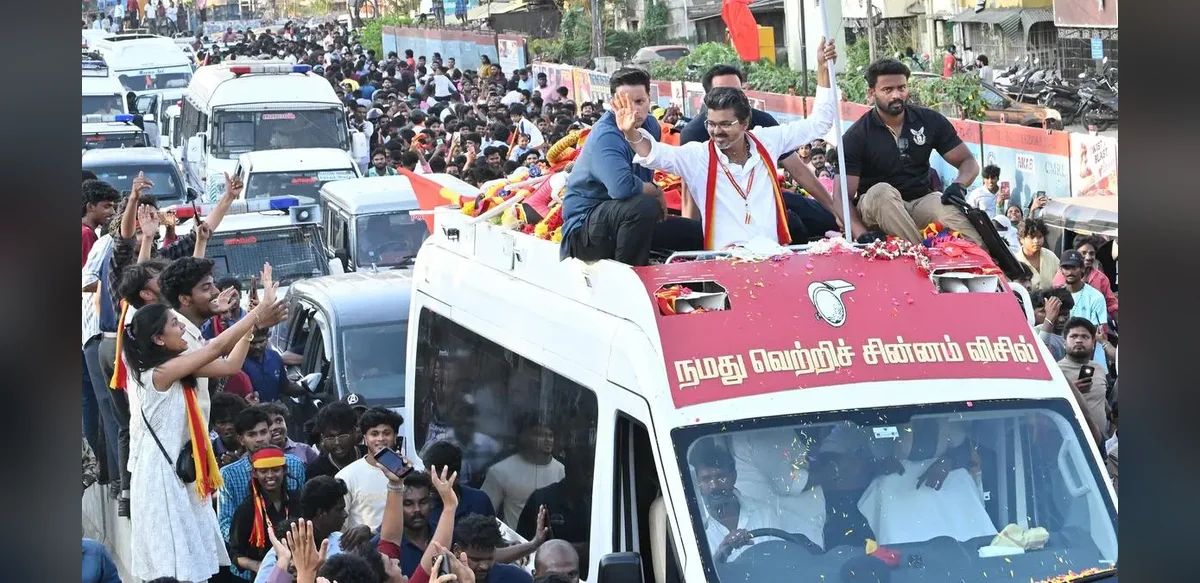
As campaigning concluded in Tamil Nadu on April 21 before the state assembly elections scheduled for April 23, political groups and analysts are pondering the preferences of voters without strong ties to any party. How might these independent individuals cast their ballots?
This issue matters because major parties rely on their core supporters, but in an election lacking a dominant trend, they are eager to attract these unaligned votes. Observers and reporters statewide have noted no clear advantage for any single party. Although actor Vijay’s entry with the Tamilaga Vettri Kazhagam (TVK) has generated excitement among some young people, it does not constitute a widespread surge.
The governing Dravida Munnetra Kazhagam (DMK) holds a steady support of 25 to 30 percent, while the All India Anna Dravida Munnetra Kazhagam (AIADMK) maintains 20 to 22 percent, slightly reduced since 2021, varying by area. National entities like the BJP and Congress, along with smaller groups including leftist organizations, command much smaller shares. ‘These figures represent the assured minimum for the main Dravidian parties,’ explained ‘Aspire’ Swaminathan, a political consultant and ex-AIADMK IT wing official.
Experts like Swaminathan suggest that most voters have already made up their minds, including those opting for NOTA. ‘The share of truly undecided voters in Tamil Nadu is small, perhaps 1 to 1.5 percent,’ he shared with Frontline. Differences also exist between rural and urban unaligned voters.
Insights from previous elections and discussions with party leaders reveal that these votes typically hinge on caste connections or a candidate’s local status. Caste often plays a central role, especially in rural areas where community ties are strong.
‘Rural electors understand key affiliations well,’ noted a senior Viduthalai Chiruthaigal Katchi (VCK) official from Perambalur, who has handled campaigns for decades. ‘Ultimately, caste influences decisions. If candidates share the same background, locality becomes the next consideration—whether they are from the area or not.’
Other elements can influence unaligned voters too. ‘Some are engaged but not loyal, while others lack any involvement,’ said analyst Raveendran Duraisamy. ‘Engaged ones often come from prominent castes or minority groups and vote tactically, with choices varying per election.’ For example, in 2024, the Social Democratic Party of India (SDPI) partnered with AIADMK, but following AIADMK’s 2026 alliance with BJP, SDPI—drawing support from Muslims, who form about 5.86 percent of the population—shifted to the DMK-led Secular Progressive Alliance (SPA).
Unaligned voters frequently belong to minor caste groups without significant influence, often residing in cities. They may include linguistic minorities or small communities. In tight races, their support is crucial, making urban independents a key target for parties.
This explains actions like the DMK’s extra manifesto launch in Chennai, the Naam Tamilar Katchi (NTK)’s unusual ad in The Hindu on April 21, and Andhra Pradesh Chief Minister N. Chandrababu Naidu’s campaigning for the AIADMK-BJP National Democratic Alliance (NDA) in Chennai that day.
The DMK aimed to gain final momentum in Chennai by emphasizing development, highlighting its commitment and leadership’s superior reputation.
For NTK, maintaining relevance is vital amid challenges in retaining supporters. It has traditionally appealed to new voters, but now faces competition from Vijay’s TVK.

