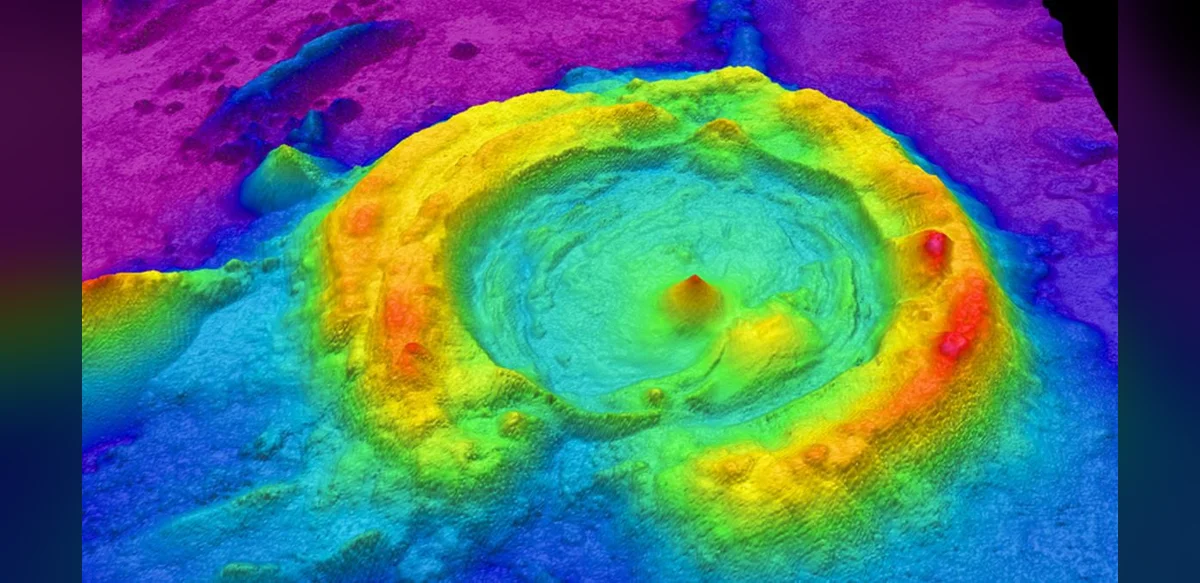
Powerful geological forces reshape the seafloor far below the ocean surface. Most volcanic activity on Earth occurs underwater, yet the resulting features have stayed largely undetected until now. Researchers led by volcanologist Andrea Verolino at Paris-Saclay University used an AI-assisted analysis of seafloor maps to locate 73 previously undocumented volcanic calderas. Calderas form as large depressions when a volcano drains sufficient magma for the overlying surface to collapse. Some remain extinct while others belong to systems that may erupt again. The team published its findings in an early-access paper in Communications Earth & Environment. The study notes that the new dataset addresses a significant observational shortfall and supplies a repeatable method for identifying submarine volcanoes, highlighting the importance of including these features in worldwide volcanic evaluations. Tectonic plate movements at underwater boundaries allow magma to ascend and construct volcanoes. While many submarine eruptions are mild and basaltic along spreading ridges, some calderas produce major events that can generate tsunamis, shock waves, ash plumes, and large steam releases. The 2022 Hunga Tonga-Hunga Haʻapai eruption from an undersea caldera illustrated these risks through atmospheric waves that reached space and tsunamis felt far away. Prior to this work, fewer than 30 submarine calderas had been recorded. The researchers adapted an algorithm first developed to detect Martian impact craters and applied it to bathymetric data. The system initially identified over 87,000 potential sites. After filtering and manual review, the team confirmed 78 probable calderas. Five matched already known examples, supporting the approach. The remaining 73 represent new discoveries that would more than triple the count of documented submarine calderas if verified. Eight lie along mid-ocean ridges, nine occur in volcanic arcs, and 61 appear in interior tectonic regions such as seamount chains. Seven candidates were flagged for priority study due to their position, depth, and form, which indicate potential relevance to volcanic hazard assessment. The paper did not evaluate current activity levels at any site. Recent research suggests some volcanoes considered extinct may still accumulate magma. The authors emphasize that the work provides a conservative baseline dataset rather than a complete inventory, one that can expand with improved mapping and further analysis. The study appears in Communications Earth & Environment.