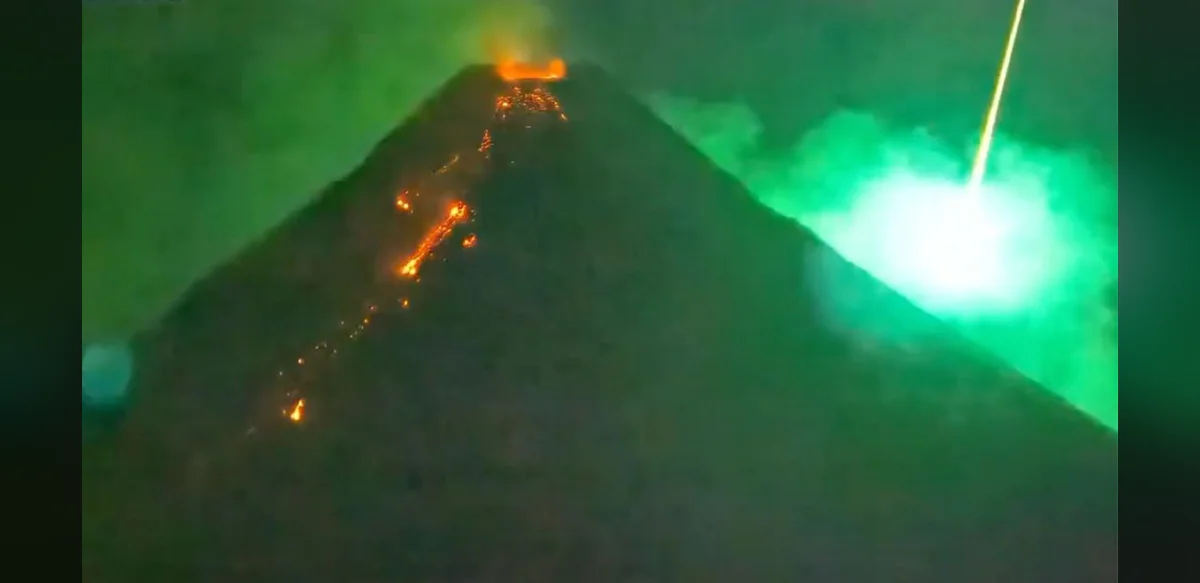
It is uncommon for a planet to show both ground eruptions and sky events at the exact same location and time. This week bright red lava streamed down the slopes of Mount Mayon in the Philippines, one of the most active volcanoes worldwide, while the night sky produced its own display. A sudden bright green fireball appeared in the atmosphere, crossed the sky, and seemed to head toward the volcano. The event was recorded on livestreams, security cameras, and vehicle dashcams. The Philippine Space Agency described it as a suspected meteor. Experts examined the videos along with seismic and sound data and concluded the object likely did not reach the ground. Most of it burned up in the atmosphere. An impact on the volcano would probably have triggered large rockfalls. The atmosphere therefore destroyed the incoming object before it could land. At the same time lava continued to flow from below. The Philippine Information Agency reported that the rare event surprised witnesses on Monday night. A government statement noted that a local amateur astronomer estimated the meteor’s energy at the equivalent of 6.8 million kilograms of gunpowder. While some researchers link fireball color to composition, others note that color can reflect atmospheric conditions or camera settings instead. The object was unlikely to be space debris, which usually produces irregular trails of fragments, unlike denser meteors that pass cleanly through the air. Such sights are striking today yet represent only a faint reminder of Earth’s earlier history. More than four billion years ago the young planet experienced frequent volcanic activity and repeated impacts from debris left over from solar system formation. The recent fireball near the Philippine volcano recalls those earlier intense conditions on a much smaller scale. During the dinosaur extinction sixty-six million years ago, numerous volcanoes were active while a large asteroid struck, likely producing many fireballs across the sky. The modern footage offers a scaled-down version of that ancient scene. The meteor over the Philippines was small by comparison. Researchers monitor larger asteroid risks, yet each day an estimated twenty-five million meteors are largely destroyed by the atmosphere. A volcanic eruption can be impressive, but a fireball in this case signals protection rather than danger, as the atmosphere shields the planet to a useful degree.