


A predator concealed in Patagonia’s ancient rock layers
The raptor that may have fished like a heron
Why this find is significant for dinosaur research
A sign that Patagonia continues to reveal hidden details
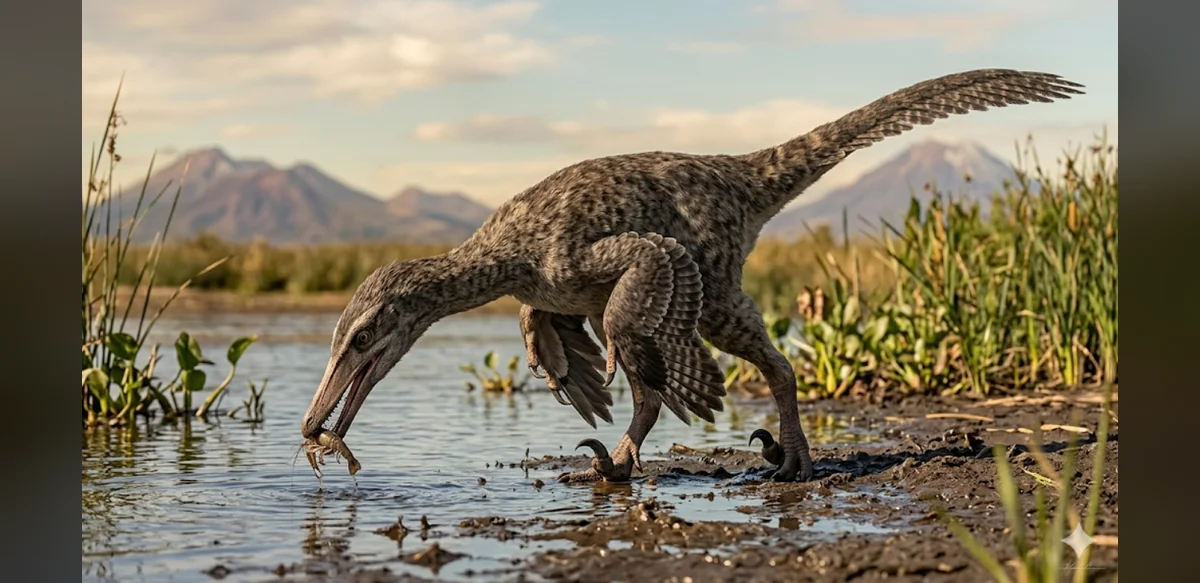
For years, dinosaurs such as Velociraptor have shaped views of swift land predators pursuing prey over arid plains. Yet in fossil deposits of southern Patagonia, researchers have identified a distinct raptor that likely spent much time motionless near rivers, waiting to seize fish. The newly named dinosaur, Kank australis, existed about 70 million years ago, shortly before the asteroid event that concluded the dinosaur era. Its fossil teeth, vertebrae and toe bones were found near El Calafate in Argentina’s Santa Cruz Province, indicating a species different from others known locally. Instead of acting as agile terrestrial hunters often shown in media, this predator shared traits with present-day herons, employing a specialized neck and pointed teeth to capture prey in wetlands and shallow waters. The find gives scientists an uncommon view of an ecosystem that thrived at the southern limit of dinosaur habitats.
The account of Kank australis emerged gradually over multiple years rather than from one intact skeleton. Details come from a study titled ‘New unenlagiid from the Chorrillo Formation (Late Cretaceous, Maastrichtian), SW Patagonia, Argentina’ in the Journal of Vertebrate Paleontology.
Researchers initially collected partial remains from the Chorrillo Formation in southern Patagonia. The bones suggested a small carnivorous dinosaur, yet evidence was insufficient to confirm a new species. A later expedition yielded a unique neck vertebra that proved decisive. Together with earlier teeth and toe bones, the material supplied enough anatomical features to establish a previously unknown dinosaur.
The genus name Kank draws from Aonikenk or Tehuelche mythology in Patagonia, referring to a giant rhea-like being linked to the Southern Cross. The species name australis means ‘from the south,’ honoring its Patagonian origin.
What distinguishes Kank australis is not only its status as a new species but its probable lifestyle. Scientists at the Argentine Museum of Natural Sciences observed neck vertebra traits indicating strong, flexible movements similar to those in wading birds like herons, which use quick strikes for fish. Its long jaws and conical teeth align with specialization for aquatic prey.
Lead author Dr. Matías Motta stated that Kank inhabited an area of rivers, streams and seasonal ponds. Fossils indicate the setting supported fish, insects, molluscs and aquatic plants, unlike today’s drier, cooler Patagonia.
Rather than chasing prey over open terrain, Kank likely waited extended periods at water edges before striking rapidly.
Though it may appear as a routine addition to dinosaur records, the species aids a broader understanding. It belongs to unenlagiids, southern relatives of Velociraptor. Prior fossils of this group appeared in South America, Antarctica, Madagascar and Australia, but links between southern Patagonia populations and others were unclear. Kank narrows that gap, supporting wide distribution across ancient southern landmasses.
The animal measured roughly 2.5 to 3 metres long, smaller than some Patagonian predators. Its discovery underscores that dinosaur-era ecosystems held greater variety than often portrayed. Not all predators were large hunters of big game. Some, like Kank australis, occupied niches along rivers and wetlands in ways reminiscent of modern birds.
More than 70 million years after its extinction, Kank australis has surfaced to add to dinosaur knowledge. The find shows that even well-examined fossil areas can yield new species. Each Patagonia discovery contributes further to the record.

