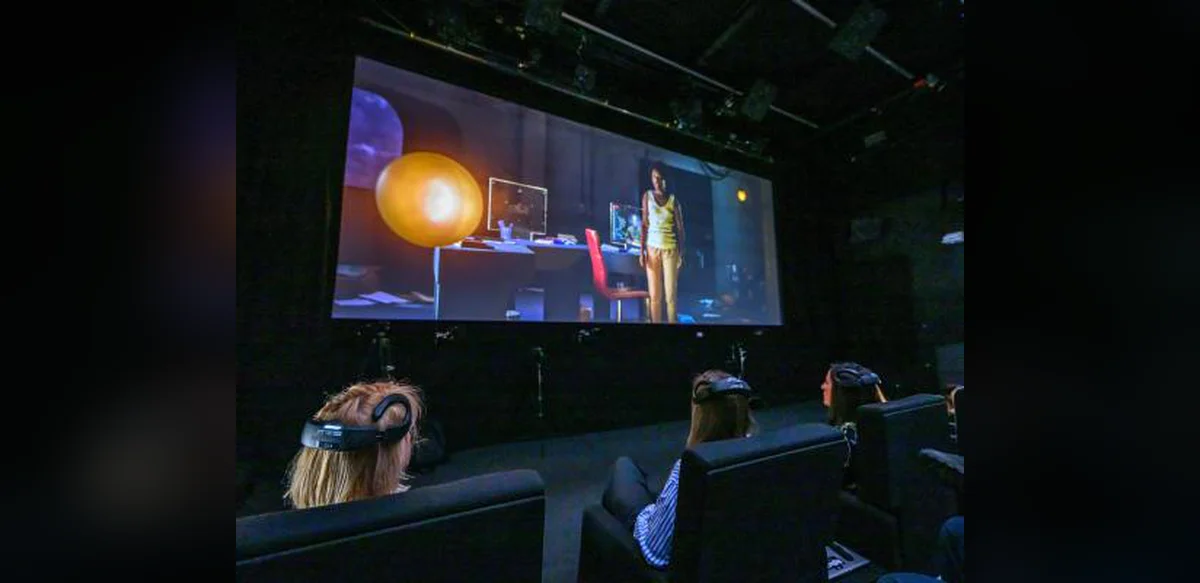
What appears to be a premium movie theater features powerful audio, a high-definition 4K display, and comfortable recliners. However, participants wear devices that track brain signals and heart rates, while infrared cameras monitor eye movements and restlessness. This unique facility at the University of Bristol allows scientists to examine audience reactions to on-screen content. By integrating physiological data with participant comments on captivating scenes, the team aims to identify elements that capture attention most effectively. These findings could assist directors in producing more compelling films and exploring innovative approaches. ‘This space functions as both a theater and a laboratory, using technology to analyze when viewers are fully absorbed,’ explained Prof. Iain Gilchrist, a neuropsychologist heading the initiative at the University of Bristol. Sensors record neural activity and pulse rates, and cameras observe gaze direction and movement. The focus is on moments when responses align across individuals, indicating strong involvement with the narrative. ‘Our data will reveal how specific sequences influence story comprehension and guide editing choices for maximum effect,’ Gilchrist noted. This week marked the first public sessions, where reactions were measured during screenings of Reno, a brief sci-fi piece examining human-AI interactions. Various groups viewed different edits of the film, with results intended to aid director Rob Hifle in finalizing the version. Hifle described the process as crucial for gauging audience connections, especially since one edit shortened a key character’s appearance. ‘It will be fascinating to observe character engagement and if the plot points are positioned correctly,’ he said. He expects no drastic alterations but anticipates unexpected insights that could refine the edit. ‘We view this as a tool to enhance audience connection, not a rigid formula. Editing typically involves just the director and editor, but additional data helps determine success.’ Hifle applied this testing late in production but sees potential for earlier stages. ‘I expect this approach to spread in the field, as audience metrics drive decisions for products and media alike.’ Yet Prof. Amanda Lotz, an expert in TV and streaming at Queensland University of Technology in Australia, doubts if such methods address core industry issues. In a diverse media environment, she argues, achievement stems from targeting specific viewers rather than seeking broad appeal. ‘Beyond uniform reactions, people seek content for varied purposes, like relaxation versus intensity, or family viewing.’ She highlights a conflict between data-driven optimization and authentic creativity. ‘True innovation emphasizes artistry over formulas derived from test group preferences.’ Conversely, Prof. Tim Smith from the University of the Arts London, who leads the Society for Cognitive Studies of the Moving Image, views the effort as a significant progress. ‘Throughout film history, creators have aimed to grasp how their choices affect viewers, but tools were limited and inexact,’ he stated. ‘This offers detailed, real-time analysis to empower directors in shaping cinema’s evolution.’ In the future, Gilchrist suggests, the methods could extend to other media. He has previously applied heart rate tracking to live concerts, discovering that in-person attendees felt more engaged and showed greater heart rate synchronization than remote viewers, signaling deeper involvement. Gilchrist acknowledged t