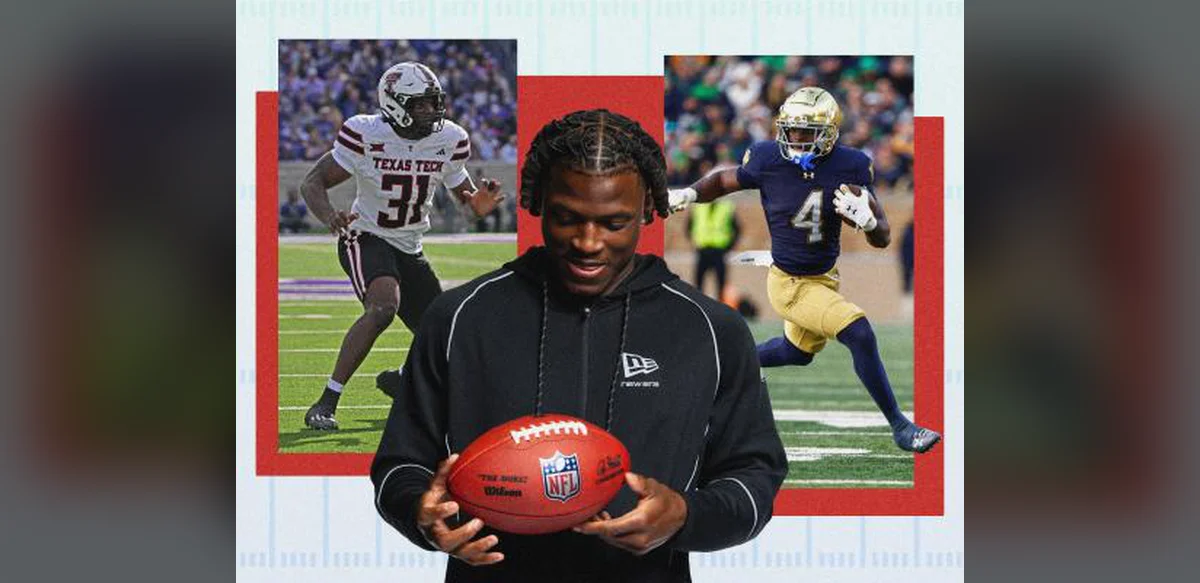
The NFL draft starts with the second overall selection this year, as the Las Vegas Raiders are expected to choose Fernando Mendoza first. The New York Jets face a choice at No. 2 between Texas Tech edge rusher David Bailey and Ohio State hybrid defender Arvell Reese. Bailey stands out as the premier pure edge rusher available, with traits reminiscent of Denver’s Nik Bonitto, including exceptional initial quickness and agility. However, his weakness in run defense raises concerns. The Jets, having traded Jermaine Johnson to the Tennessee Titans, need more explosiveness from their pass rushers. While Bailey could become a dominant force, the team must determine if he can handle all downs or remain limited to passing situations. Reese is considered the top overall talent in the draft. At Ohio State, he operated mainly as an off-ball linebacker with some edge duties. He brings explosiveness, physicality, and intelligence, capable of lining up across the defensive line. Many scouts see him transitioning to a full-time edge role in the pros, though his college experience in that position is limited. Comparisons to Micah Parsons have surfaced, who shifted from linebacker to edge after being picked by Dallas in 2021. Unlike Parsons, Reese lacks high school edge experience and excels more as a linebacker. Selecting him solely for edge duties involves risk, as he admitted to relying on instincts rather than technique when rushing the passer. The Jets seek impactful defenders and aim for greater defensive flexibility, making Reese an ideal fit. He could anchor the unit, playing linebacker on early downs and varying positions in passing scenarios. Overlooking him might prove regrettable. Regarding the Tennessee Titans’ fourth pick, speculation centers on Notre Dame running back Jeremiyah Love. Debates persist about the wisdom of early first-round running back selections, but history shows strong success rates for top-15 picks since 2016, including stars like Ezekiel Elliott, Leonard Fournette, Christian McCaffrey, Saquon Barkley, Bijan Robinson, Jahmyr Gibbs, and Ashton Jeanty. Five of these seven have thrived, with only Fournette underperforming and Jeanty’s career just beginning. These players often excel in receiving and blocking roles. Love fits this profile as a dynamic runner and receiver, with nearly half his college rushing yards from runs of 15 yards or more—a rare statistic. He averaged 10.4 yards per catch in his last season and excels at evading tackles to create big gains. New Titans coach Robert Saleh might advocate for a defensive standout, with several options likely available. However, the team prioritizes adding an offensive cornerstone alongside quarterback Cam Ward. While a receiver like Ohio State’s Carnell Tate could offer better positional value, Love’s allure might be irresistible. Alabama quarterback Ty Simpson generates divided opinions as a prospect. Some view him as the most refined passer ready for immediate contributions, while others criticize his size, durability, accuracy, and decision to enter the draft after one starting season. Consensus holds that he will be the second quarterback chosen. In Alabama’s pro-oriented, aggressive offense under former Seattle coordinator Ryan Grubb, Simpson shone early in the year. His style mirrors Brock Purdy’s as a mobile, pocket-tough distributor who attacks downfield and middle zones with precision and boldness. He lacks flashy traits but demonstrates fearlessness in his approach.