


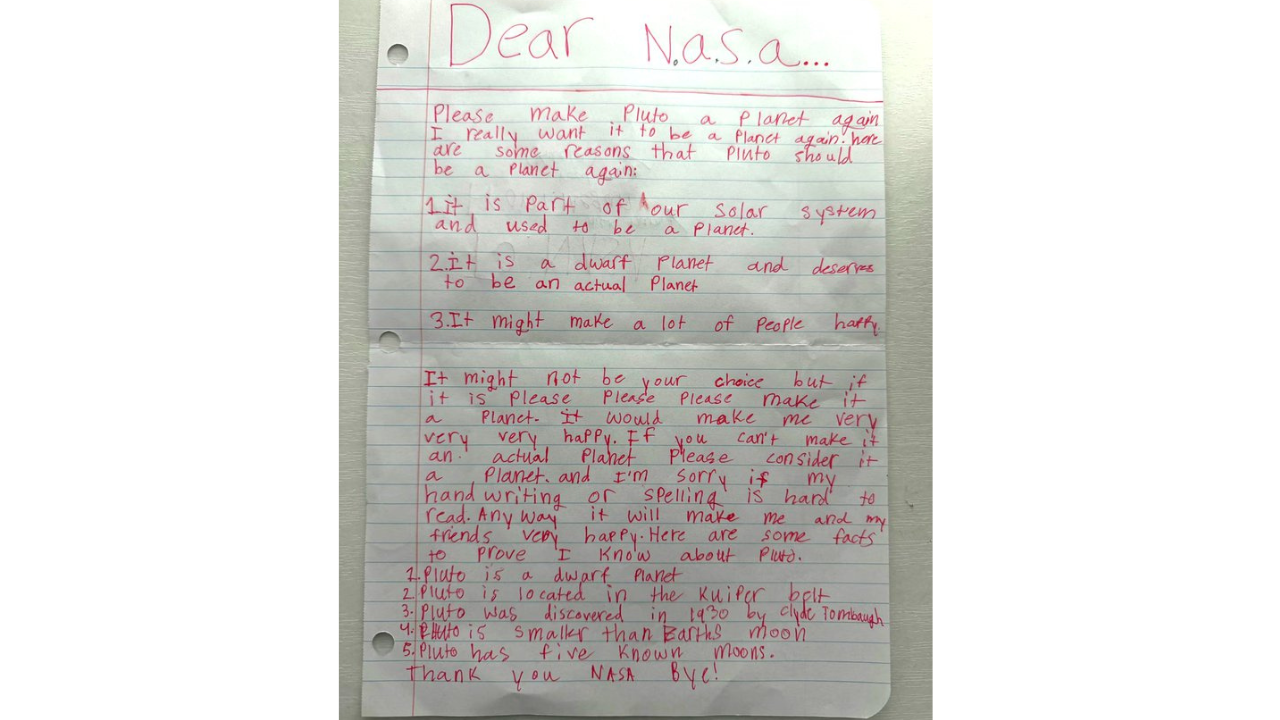
A 10-year-old girl named Kaela sent a handwritten letter to NASA, advocating for Pluto to be recognized once more as a planet. She highlighted its significance in the solar system and the happiness it could bring to people. The letter gained significant attention when NASA Administrator Jared Isaacman replied on social media, stating, ‘We are looking into this.’ This interaction has been praised as an inspiring example of engaging with young people’s curiosity about space.
Kaela’s message was notable for its honest and straightforward approach. She recognized Pluto’s current status as a dwarf planet but challenged the reasons for not restoring its previous designation. She included a personal appeal, noting that such a change would delight many individuals. The story spread rapidly online, shared by various users and attracting comments from astronomy fans and the broader audience.
In 2006, the International Astronomical Union redefined planetary criteria, requiring an object to orbit the sun, maintain a spherical form, and dominate its orbital path. Pluto satisfies the first two requirements but fails the third due to sharing its Kuiper Belt area with other bodies, resulting in its dwarf planet label—a decision that still generates controversy.
For numerous people, this reclassification disrupted the traditional view of a nine-planet solar system long presented in education. Kaela’s inquiry reflects ongoing nostalgia for that model, where Pluto held the position of the ninth planet, fueling continued debate.
Although an official shift in Pluto’s status seems improbable, this episode underscores the value of connecting with the public on scientific topics. Isaacman’s reply to a child’s question transformed a simple act into a broadly appreciated event, illustrating how space exploration fosters enduring fascination among all age groups.

