


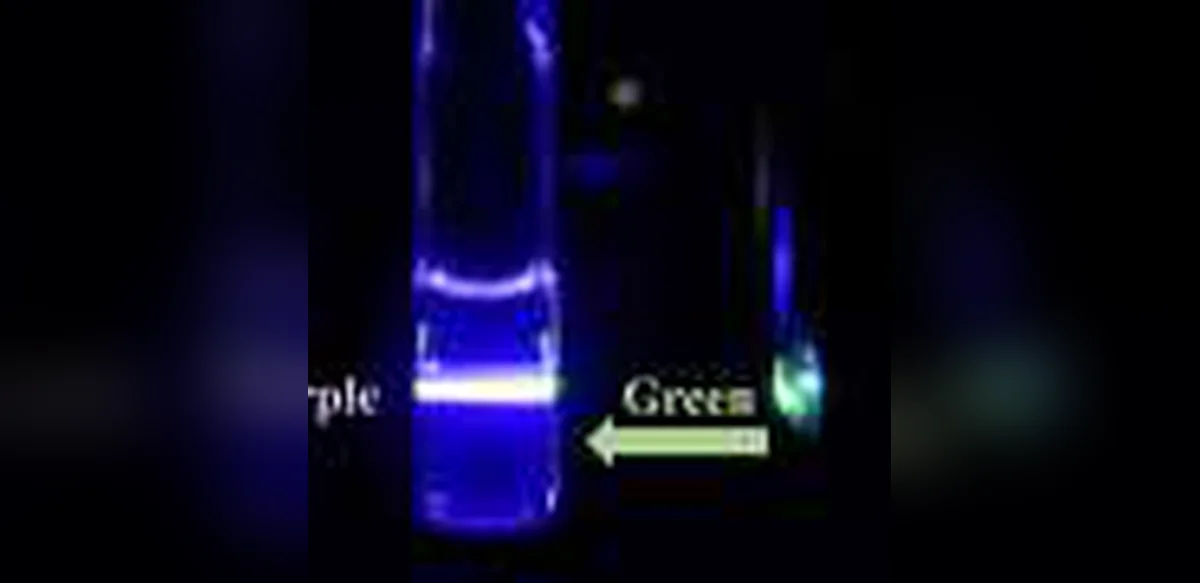
Solar cells and photocatalysts often operate below peak performance because they capture only a narrow band of light wavelengths. Longer wavelengths tend to pass through unused. Photon upconversion, especially the triplet-triplet annihilation method, offers a way to turn low-energy light into shorter, more usable wavelengths.
Researchers at Osaka Metropolitan University created a new acceptor molecule called TP-An that achieves high-efficiency upconversion even under weak light. The work appears in the Journal of the Physical Chemistry Letters.
Common acceptor molecules lose performance at higher concentrations needed for real devices. TP-An avoids this problem and maintains a fluorescence quantum yield above 99 percent. Tests with green light at 533 nanometers produced purple emission at 413 nanometers, confirming successful upconversion. The upconversion quantum yield reached roughly 23 percent.
The team plans next to develop materials that handle a wider light spectrum and function efficiently in solid form, with possible uses in photocatalysis and solar technologies.

