


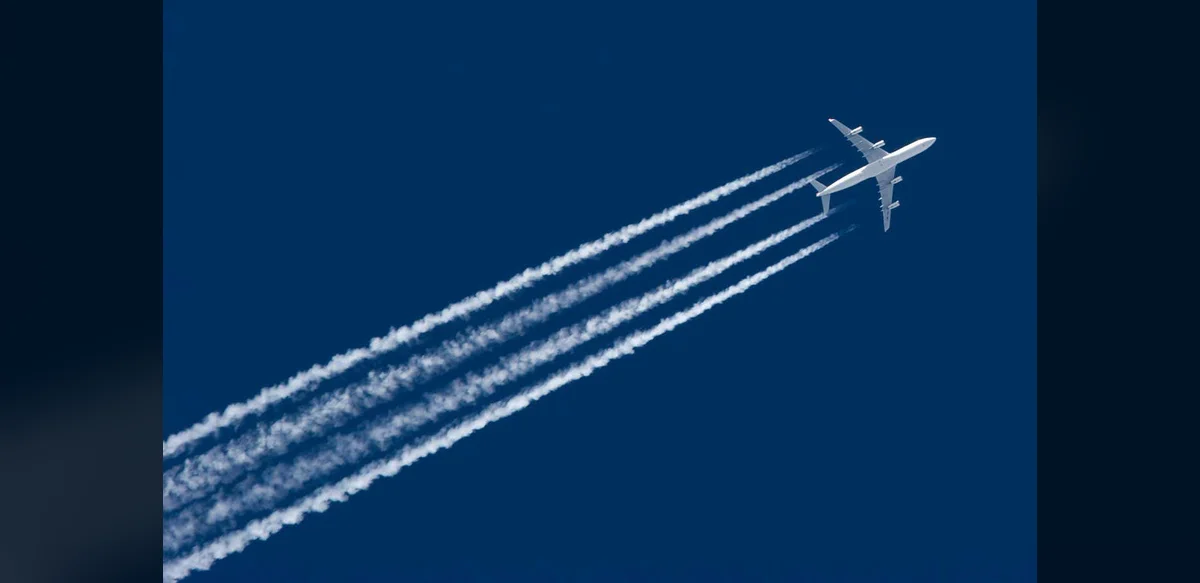
A proposed method to combat global warming by releasing sun-reflecting particles near the poles could cause commercial flights to encounter clouds of sulphuric acid, creating risks for passengers and crew.
Airliners might fly through such acid clouds if solar geoengineering plans proceed. Spraying reflective particles near the poles to offset rising temperatures could subject passengers on specific routes to dangerous concentrations of sulphuric acid.
With the planet heading toward as much as 3.7°C of warming by 2100, interest in blocking sunlight to lower temperatures is increasing. The leading concept calls for injecting sulphur into the stratosphere to mimic cooling effects from major volcanic eruptions.
Releasing these substances high in the atmosphere near the equator for maximum effect would need new aircraft capable of reaching 20 kilometres, roughly double the ceiling of current planes.
Researchers are therefore examining whether upgraded Boeing 777s or similar models could release the compounds near the poles, where the stratosphere begins at only 7 kilometres. This approach raises concerns for routes such as those between Asia and North America that cross polar areas.
Alan Robock of Rutgers University notes that any aircraft able to spray the sulphur would share airspace with passenger flights. He calculated potential exposure levels for travellers and crew passing through the resulting clouds.
Earlier simulations examined injecting 6 million tonnes of sulphur dioxide near each pole during appropriate seasons, for a yearly total of 12 million tonnes. Models indicate this volume could reduce global temperatures by 0.6 to 1.0°C. Robock’s team applied the predicted acid concentrations to assess cabin pollution.
The geoengineering flights would create narrow plumes that disperse over days or weeks. Passenger planes might encounter zones with cabin levels around 7 micrograms per cubic metre, below many urban ground readings. Other areas could exceed 50 micrograms per cubic metre, the threshold the European Union considers hazardous.
Inhalation of sulphur dioxide irritates the throat and lungs and can worsen respiratory conditions or raise stroke risk. Even lower amounts may provoke asthma. Pilots and cabin crew on repeated polar routes would face the greatest exposure.
Wake Smith of Harvard University observes that such operations remain decades away, allowing time to improve cabin filters. Daniele Visioni of Cornell University describes the findings as useful but not decisive, with other risks appearing more significant.
Journal reference: Geophysical Research Letters DOI: 10.1029/2026GL122804

