


This article has been reviewed according to Science X’s editorial process and policies. Editors have highlighted the following attributes while ensuring the content’s credibility:
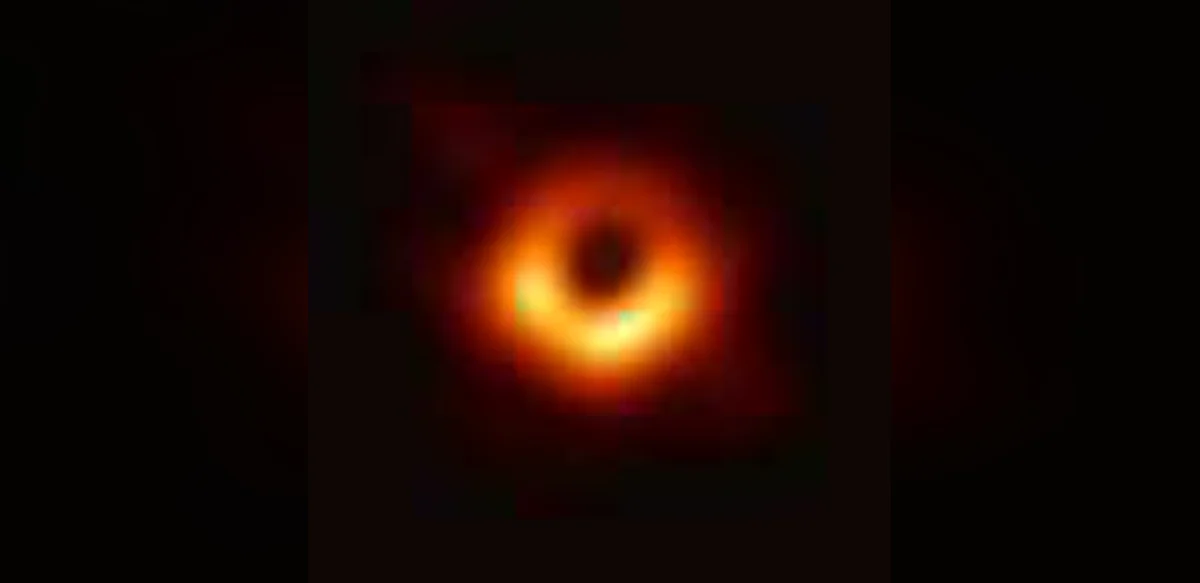
First ever image of a black hole, taken by the Event Horizon Telescope. Credit: EHT Collaboration
Reports on academic papers about the Solar Gravitational Lens appear regularly. This stems partly from Dr. Slava Turyshev’s high output of studies and partly from the mission’s significant promise along with remaining technical issues. A recent paper posted to the arXiv preprint server by Dr. Turyshev highlights an underappreciated capability of the SGL: its value for imaging objects beyond distant exoplanets.
The SGL relies on a general relativity effect in which the sun’s mass bends and amplifies light. A spacecraft placed about 550 AU from the sun could harness this lensing to produce megapixel-scale images of Earth-like exoplanets located several dozen light-years away.
Development of the SGL has centered on exoplanets, yet Turyshev notes many other targets could yield high-resolution images. Exoplanets present a major issue called photon starvation, requiring long observation times to overcome background noise from the sun’s corona.
Objects that emit their own light avoid this limitation. For such targets, calculations shift to focal-line navigation, detector dynamic range, and removal of coronal glare. Turyshev examined the mathematics for three notable applications.
One involves mapping the surface of a magnetic white dwarf. These compact, luminous remnants are roughly Earth-sized. Current observations resolve white dwarf surfaces only to the microarcsecond level. Turyshev calculates that the SGL could achieve nanoarcsecond resolution for a white dwarf 10 parsecs away, revealing temperature variations and rocky debris in accretion belts.
A second case concerns the supermassive black hole M87*, previously imaged by the Event Horizon Telescope. That image had a resolution of tens of microarcseconds. Turyshev demonstrates the SGL could reach 0.66 microarcseconds per pixel, representing a substantial gain.
A third application targets specific regions within protoplanetary disks. Scanning an entire 100 AU disk would prove impractical because the spacecraft must travel along a focal line. However, the SGL could examine localized areas of interest, such as zones of active planet formation.
A key constraint remains: the spacecraft must move along a focal line rather than a plane. Shifting the view by one degree at 650 AU would require traveling farther than the distance from Earth to Saturn, taking years or decades with current propulsion.
Without improved propulsion and solutions to other technical challenges, the SGL stays conceptual. Ongoing papers and technological progress continue to advance the concept, adding justification for its development.
Publication details: Slava G. Turyshev, Ultra-High-Resolution Astronomy with the Solar Gravitational Lens, arXiv (2026). DOI: 10.48550/arxiv.2606.18300

