


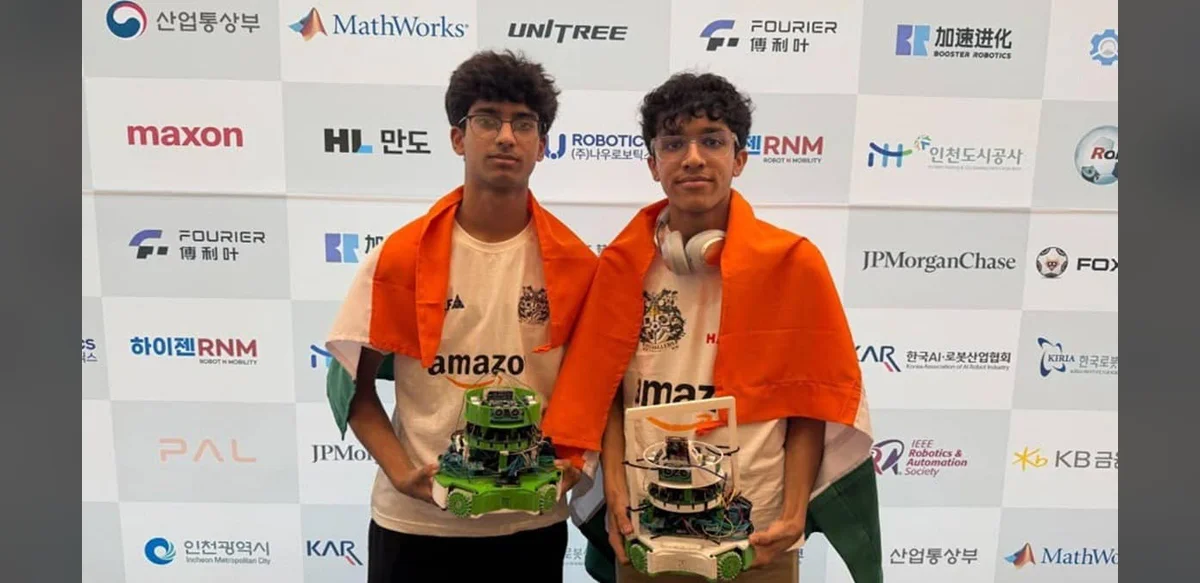
Two school students from India, operating as a team of two, entered a pair of robots in an international soccer competition and finished ninth. Kushal Sachdeva and Darsh Goel, competing as VVS Ballers, achieved ninth place in the RoboCupJunior Soccer Infrared division at RoboCup 2026 in Incheon, South Korea. The achievement stands out because the robots came from two teenagers who designed, assembled and programmed the machines without support from a large institution.
RoboCup ranks among the largest robotics events worldwide and attracts teams from many countries. Its junior section includes a soccer league where small wheeled robots play two against two. The machines operate without remote control. Once a match begins, each robot must detect the ball and make decisions independently until the game ends.
The Infrared category uses a ball that emits infrared light. Robots locate it with special sensors instead of standard cameras. The field is green with white markings. A goal is scored only when the ball reaches the back of the net. Touching a wall or entering the penalty area results in a one-minute removal from play. This year the league adopted a smaller 42-millimetre infrared ball, requiring sensor adjustments. The core challenge remains locating the ball, pursuing it and scoring while staying within boundaries.
VVS Ballers consists of two members with distinct roles. Sachdeva manages electronics, custom circuit boards, software and most computer-aided design. Goel oversees mechanical design and shares the CAD tasks.
The team fields two identical robots assigned different tasks through software. One acts as attacker, aiming to gain possession and score. The other serves as defender or goalkeeper, positioned near the goal to block and clear the ball while avoiding the penalty area.
Each robot contains five custom circuit boards. A main board with a Teensy 4.1 microcontroller controls movement and kicking. A sensor board uses sixteen infrared receivers to track the ball. Another board detects boundary lines with downward sensors. Ultrasonic sensors measure distances to walls. A power board supplies required voltages. An OpenMV camera helps the attacker locate the goal. An inertial sensor maintains straight movement. Omni-directional wheels allow sideways motion without turning. The attacker employs a solenoid kicker operating at 48 volts.
The students built the circuit boards, wrote firmware, 3D-printed parts and coordinated the robots. They advanced through Indian regional and national events before competing internationally and finished ninth overall.

